Quick Answer
If you have a joint mortgage during divorce, both borrowers usually remain fully responsible for the repayments, even if one person moves out or agrees otherwise informally. If payments are missed, arrears may be recorded and both credit files can be affected, which may impact future borrowing and mortgage options.
Understanding a Joint Mortgage During Divorce
A joint mortgage during divorce can quickly become stressful because the mortgage agreement usually stays exactly the same until the lender formally agrees to any changes. Even if one person moves out, stops contributing or informally agrees that the other person will pay the mortgage alone, both names may still remain fully responsible for the monthly payments. If payments are missed, both credit files could potentially be affected.

Across Brighton, Hove, Worthing, Shoreham, Lewes and wider East and West Sussex, many separating couples are surprised to discover how much ongoing financial connection can remain through a joint mortgage. Understanding your responsibilities early may help you avoid arrears, credit problems and rushed decisions about the family home while you explore your longer-term mortgage options.
1. Divorce Does Not Automatically Change the Mortgage
Many people assume that once separation or divorce begins, the mortgage automatically changes too. In practice, that is usually not the case. A joint mortgage during divorce normally remains exactly as it was until the lender formally agrees to remove someone, transfer ownership or replace the mortgage with a new arrangement.
The Mortgage Contract Usually Stays the Same
If both names are still on the mortgage, both borrowers are typically still fully responsible for the payments, regardless of who lives in the property or what has been agreed privately between the couple. Lenders describe this as “joint and several liability”, meaning they may pursue either person for the full monthly payment if arrears occur.
This is one of the biggest financial risks people face during divorce. For example:
- One person may move out believing they are no longer connected to the mortgage
- The remaining partner may agree to cover the payments alone
- A verbal agreement may exist between both parties
However, from the lender’s perspective, the original mortgage agreement may still remain fully active until formal changes are completed.
Moving Out Does Not Automatically Remove Liability
Across Brighton and Hove, it is common for one partner to temporarily move into rented accommodation while the other remains in the family home with children. Even in these situations, the departing partner may still remain liable for the mortgage if their name is still attached to the loan.
In Worthing or Shoreham, some separating couples also choose to delay selling the property while deciding whether one person may eventually buy the other out. While this can sometimes provide short-term stability, both borrowers may remain financially linked during that period.
If payments are missed during this time:
- both credit files may potentially be affected
- arrears may appear on both records
- future mortgage applications could become more difficult
- the lender may still contact either borrower for payment
A Divorce Agreement Does Not Automatically Override the Lender
Even where there is a financial consent order or private agreement stating that one person should pay the mortgage, the lender does not automatically have to accept that arrangement. Before removing someone from a mortgage, lenders will usually want to see:
- that the remaining borrower can afford the mortgage alone
- satisfactory income and affordability checks
- acceptable credit history
- confirmation of the legal ownership changes where relevant
This is why many people going through divorce across East Sussex and West Sussex choose to speak to both a solicitor and Everest Mortgages early in the process. As a whole-of-market mortgage broker, we can help you understand whether keeping the property, transferring the mortgage or remortgaging may be possible, before any formal application is made.
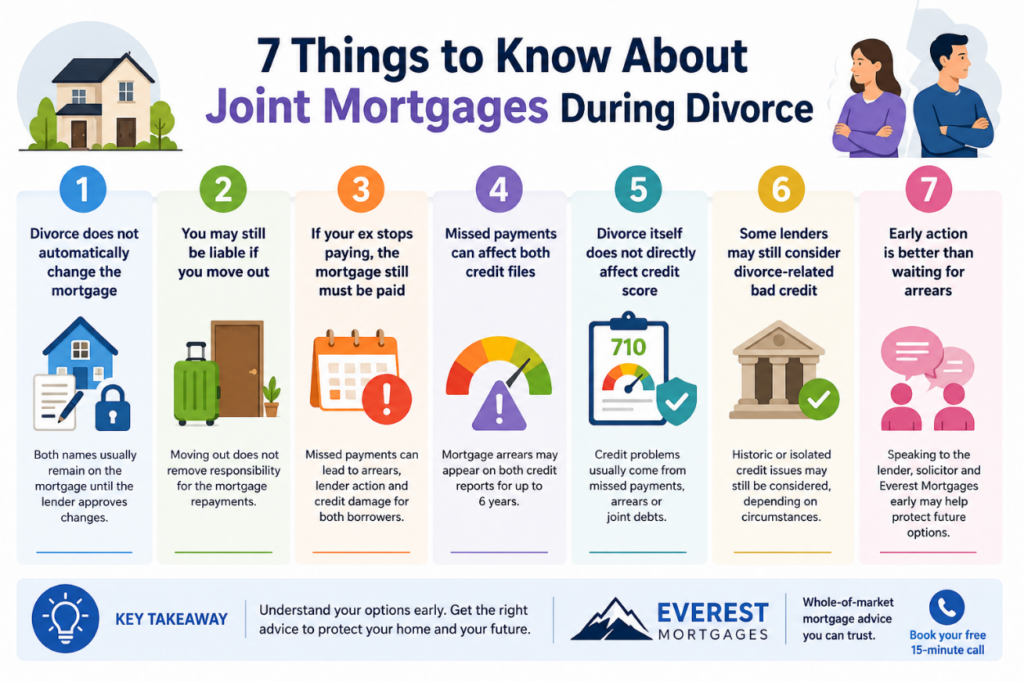
2. You May Still Be Liable Even If You Move Out
Moving out of the property does not usually remove your responsibility for a joint mortgage during divorce. If your name is still on the mortgage agreement, the lender will normally continue treating both borrowers as fully liable for the debt.
Informal Agreements May Not Protect You
Many separating couples make temporary private arrangements such as:
- one person staying in the property
- one partner covering the mortgage alone
- splitting payments informally
- delaying a sale until later
However, lenders are not normally bound by these agreements unless the mortgage itself is formally changed.
For example, somebody in Hove may move into rented accommodation while their ex-partner stays in the jointly owned property. Even if they agree that the remaining partner will pay everything, both names may still remain linked to the mortgage account and both credit files may still be exposed if payments are missed.
The Lender Can Still Pursue Either Borrower
With most joint mortgages, both borrowers remain “both borrowers remain jointly and severally liable”. This means the lender may legally pursue either person for the full monthly payment, not just their assumed half. In practical terms, this could mean:
- arrears letters being sent to both parties
- collections activity affecting both borrowers
- affordability problems when applying for another mortgage
- difficulties passing future credit checks
Even if one person has not lived in the property for months, the lender may still expect the mortgage to be maintained in full.
Credit Impact Can Continue After Separation
A joint mortgage usually continues appearing on both credit files until the mortgage is redeemed, transferred or refinanced. If your ex misses payments, this may still affect your borrowing position later.
This becomes particularly important for people in Brighton, Worthing and wider West Sussex who later want to apply for a new mortgage alone after separation. Some lenders may question ongoing joint liabilities, missed payments or financial links that still appear on the credit report.
3. If Your Ex Stops Paying, the Full Payment Still Needs to Be Made
One of the most financially damaging situations during divorce is when one person stops contributing towards the mortgage. Even if your ex was supposed to pay their share, the lender will normally still expect the full monthly payment to be made on time.
Missing One Payment Can Trigger Arrears
In the UK, a single missed mortgage payment places the account into arrears. Lenders are then required to contact borrowers about the missed payment and may begin discussing repayment arrangements.
According to recent UK mortgage guidance, one missed mortgage payment may reduce a credit score by approximately 50–100 points depending on the individual profile and lender reporting (Nesto UK Guide, updated 2025).
Both Borrowers May Be Contacted
If payments stop, lenders may contact:
- both borrowers by letter or phone
- both parties regarding arrears
- either borrower for the full amount owed
This often catches separating couples by surprise. For example, somebody in Shoreham may believe their ex-partner is maintaining the mortgage, only to later discover missed payments have already been reported on both credit files.
Ongoing Arrears Can Affect Future Borrowing
Mortgage arrears may stay visible on credit reports for years and can make future borrowing more difficult. Some mainstream lenders may become more cautious where recent missed payments appear, particularly if arrears are unresolved or repeated. This may affect:
- future residential mortgage applications
- remortgaging options
- affordability assessments
- interest rates available
- credit card or loan applications
Some lenders may still consider applications involving historic missed payments caused by divorce or separation, depending on how recent the arrears were, the overall credit profile and current affordability position.
Repossession Risk Increases if Arrears Continue
Repossession is normally treated as a last resort by lenders, but persistent arrears can eventually lead to legal action if the mortgage remains unpaid.
Under current FCA mortgage guidance, many lenders signed to the Mortgage Charter have agreed not to force repossession within 12 months of the first missed payment unless exceptional circumstances apply (Shelter England guidance referencing FCA Mortgage Charter, accessed 2026).
4. Missed Payments Can Affect Both Credit Files
With a joint mortgage during divorce, missed payments are usually reported against both borrowers if both names remain on the mortgage account. This can happen even where only one person was responsible for making the payment informally.
Mortgage Arrears May Stay Visible for Years
In the UK, missed payments and mortgage arrears normally remain on a credit file for 6 years from the date they are recorded (ClearScore UK, accessed May 2026).
This means a missed payment linked to a divorce in Brighton or Worthing could still appear when applying for another mortgage years later. Lenders reviewing a mortgage application may look at:
- how recent the missed payments were
- whether the arrears involved a mortgage or unsecured debt
- how many payments were missed
- whether the account has since been maintained properly
- whether there is an explanation linked to separation or divorce
Missed mortgage payments are generally treated more seriously than missed credit card or mobile phone payments because the debt is secured against a property.
Future Borrowing May Become More Difficult
If arrears appear on both credit files, it may affect:
- remortgaging options
- affordability assessments
- credit scoring
- interest rates available
- the number of lenders willing to consider the application
For example, somebody in Shoreham may discover their ex-partner missed several joint mortgage payments after separation. Even if the applicant personally paid all other bills on time, the mortgage arrears may still appear on both files because the mortgage remained joint.
Some lenders may still consider applications involving historic missed payments caused by divorce, depending on:
- current affordability
- deposit size or available equity
- how old the missed payments are
- whether the credit profile has stabilised since
This is often where whole-of-market mortgage advice from Everest Mortgages can help you understand which lenders may be more flexible in separation-related cases, based on your individual circumstances.
5. Divorce Itself Does Not Directly Damage Your Credit Score
Divorce on its own does not appear on your credit file and is not reported to credit reference agencies. What affects your credit position is the financial disruption that can happen around separation, especially where joint commitments continue.
What Actually Impacts Credit During Divorce
The main risks usually come from ongoing financial links and payment breakdowns, such as:
- missed mortgage payments or arrears
- joint loans or credit cards falling behind
- overdrafts or credit accounts being unmanaged
- defaults or CCJs from unpaid debt
- continued financial association with an ex-partner
In places like Hove and Brighton, this often happens where one person assumes the other is maintaining the mortgage or household bills, but payments are missed without either party fully realising until arrears are recorded.
Financial Links Can Continue After Separation
Even after moving out, lenders may still connect former partners if joint accounts remain active. This can continue to influence future borrowing decisions. Common ongoing financial links include:
- joint mortgage
- joint credit cards
- shared loans or overdrafts
- some utility or household credit accounts
This is why people across Lewes, Worthing and West Sussex often review their credit files early after separation, to understand what financial ties still exist before applying for a new mortgage.
6. Bad Credit Caused by Divorce May Still Be Considered by Some Lenders
Having credit issues during or after divorce does not automatically prevent you from getting a mortgage. Many lenders assess the wider context, especially where financial difficulty was temporary and linked to separation rather than long-term money problems.
What Lenders Focus On
Instead of treating all adverse credit the same, lenders usually look at the full picture, including:
- how recent the missed payments or arrears are
- whether the issue has now been resolved
- current income stability and affordability
- whether credit behaviour has improved since
- level of equity or deposit available
Recent mortgage arrears are usually treated more seriously, while older, isolated issues linked to a specific life event such as divorce may carry less weight, depending on lender criteria.
Equity and Deposit Can Strengthen the Case
Available equity or deposit can sometimes help offset past credit issues. In higher-value areas like Brighton and Hove, separating couples may have more equity built up, which can support remortgage or transfer-of-equity discussions, subject to affordability.
For example, someone in Worthing who experienced short-term arrears during separation but now has stable income and significant equity may still have access to selected lenders, depending on overall profile.
Why Clear Explanation Still Matters
Lenders often take a more flexible view where credit issues clearly relate to divorce-related disruption, especially when:
- payments were affected during separation or legal delays
- one party unexpectedly stopped contributing
- short-term financial pressure caused missed payments
- the account has been well-managed since
Across Shoreham and wider East and West Sussex, this is where early advice can be important. A broker can help identify lenders that may be more open to considering historic issues within the context of divorce rather than treating them in isolation.
7. Early Action Is Better Than Waiting for Arrears
One of the biggest mistakes during a joint mortgage during divorce is waiting until payments are already being missed before asking for help. Early action may help protect both credit files and provide more mortgage options later.
Speak to the Lender Before Payments Are Missed
If financial pressure is developing, contacting the lender early is usually viewed more positively than ignoring the problem. Depending on circumstances, some lenders may discuss:
- temporary payment arrangements
- term extensions
- interest-only periods
- short-term support options
Legal and Mortgage Advice Often Need to Work Together
Mortgage decisions during divorce often overlap with ownership arrangements, equity division, financial consent orders, transfer of equity and decisions about whether the property may eventually need to be sold.
At the same time, speaking to a mortgage broker early may help you understand whether keeping the property is realistically affordable, whether one person may be able to take over the mortgage, and how existing credit issues could affect future borrowing options.
Early Advice May Help Preserve Future Options
In East Sussex and West Sussex, many people only seek mortgage advice after arrears, defaults or credit problems have already developed. By that stage, lender options may sometimes be more limited. Taking advice earlier may help with:
- protecting credit profiles
- avoiding unnecessary missed payments
- planning a future remortgage
- understanding affordability before agreements are finalised
If divorce has affected your joint mortgage or credit position, book your free 15-minute call with Everest Mortgages. We can help you understand what lenders may consider before you apply.
Speak to Everest Mortgages
If you’re dealing with a joint mortgage during divorce, getting clear advice early may help you avoid arrears and understand your real options before decisions are made. Whether you’re looking to stay in the home, explore a buyout, or check affordability on a single income, lenders will assess your situation based on individual circumstances and criteria.
Everest Mortgages provides whole-of-market mortgage advice across Brighton, Hove, Worthing, Shoreham, Lewes and wider East and West Sussex, helping you understand what may be possible during separation.
Book your free 15-minute call with Everest Mortgages to discuss your options and next steps.
FAQs – Joint Mortgage During Divorce
1. What happens if my ex stops paying the mortgage?
If your ex stops paying, the lender will still expect the full monthly mortgage payment to be made. Because the mortgage is a joint agreement, both borrowers are usually responsible for the debt, so arrears may build quickly and the lender can pursue either party for payment.
2. Am I still liable if I move out?
Yes, if your name remains on the mortgage, you are typically still fully liable even if you move out. Moving home or agreeing informally with your ex does not change the lender’s contract unless a formal transfer of equity or remortgage is completed.
3. Can missed payments affect both credit files?
Yes. If the mortgage is in joint names, missed payments are usually recorded on both credit files. This can affect future borrowing for both parties, even if only one person failed to make the payment.
4. Does divorce affect your credit score?
No, divorce itself does not appear on your credit file and does not directly damage your credit score. What can affect your score are financial issues linked to separation, such as missed payments, joint debts, or arrears.
5. Can I get a mortgage after missed payments?
Yes, it may still be possible, depending on how recent the missed payments were, how severe they were, and whether your financial situation has improved since. Some lenders may still consider applicants with historic adverse credit, subject to affordability and lender criteria.
Sources and References
This article is based on general UK mortgage guidance and widely published industry information as of 2025–2026, including:
- UK mortgage lender guidance on joint and several liability and arrears reporting (MoneySavingExpert, accessed 2026)
- UK credit reporting rules and adverse credit visibility periods (ClearScore UK guidance, accessed 2026)
- UK mortgage arrears and lender forbearance guidance under FCA Mortgage Charter and repossession framework (Shelter England, accessed 2026)
- General UK adverse credit mortgage criteria trends relating to timing, severity and affordability assessment (UK broker and lender industry guidance, 2025–2026)
This content is for general information only and does not constitute financial or legal advice. For legal matters relating to divorce, ownership or financial settlements, you should speak to a qualified solicitor.