



Quick Answer
Yes, getting a mortgage after an IVA or bankruptcy is possible, although your options may be more limited. Many applicants need to consider specialist lenders, a larger deposit and the time since their insolvency arrangement was completed. Your eligibility will depend on your credit history, financial circumstances and individual lender criteria.
Key Takeaways
- Timing matters: Your mortgage options may improve once your IVA or bankruptcy has been completed and more time has passed.
- Deposits can be higher: Some lenders may require a larger deposit to offset the perceived risk.
- Specialist lenders may help: Some lenders consider applicants with previous or current adverse credit, subject to their criteria.
- Your credit file matters: An IVA or bankruptcy can affect your credit history for several years, so checking your records is important.
- Get advice before applying: A specialist mortgage broker can help you understand your options and identify lenders whose criteria may suit your circumstances.
On this page
- What Is an IVA and Why Does It Affect a Mortgage Application?
- Can I Get a Mortgage While I’m Still in an IVA?
- How Long After an IVA Can I Get a Mortgage?
- How Long Does an IVA Stay on Your Credit File?
- How Much Deposit Do I Need for a Mortgage After an IVA?
- Which Lenders Accept Applicants with an IVA?
- Will I Pay a Higher Interest Rate After an IVA?
- Joint Mortgages When One Partner Has an IVA
- Right to Buy, Shared Ownership and Buy-to-Let After an IVA
- How to Improve Your Chances of Getting a Mortgage After an IVA
- Documents You’ll Need
- Do I Have to Declare a Past IVA?
- Case Study: Helping a Client Get a Mortgage After an IVA
- Speak to an IVA Mortgage Broker in Brighton
- Frequently Asked Questions
today
Find out how much you could borrow in minutes. No credit check, no commitment – just clear, honest mortgage advice.
What Is an IVA and Why Does It Affect a Mortgage Application?
An Individual Voluntary Arrangement (IVA) is a legally binding agreement between you and your creditors to repay your unsecured debts over an agreed period. It is managed by a licensed Insolvency Practitioner (IP), who oversees the arrangement and payments.
An IVA can affect your mortgage application because lenders may see it as a sign of previous financial difficulties. If you’re also considering shared ownership, having a poor credit history can create additional challenges, as explained in our guide to shared ownership mortgages with bad credit.
- IVA status: Whether your IVA is active or completed.
- Credit history: When it started and whether payments were maintained.
- Income and affordability: Whether you can manage the mortgage repayments.
- Deposit: How much you can put towards the property.
- Time since completion: How long ago the IVA ended.
An IVA usually stays on your credit file for six years from its start date. However, it does not automatically prevent you from getting a mortgage. Some specialist lenders consider applicants with an IVA, depending on their circumstances and individual lending criteria.
Bankruptcy is a separate insolvency process involving the management of your assets to repay creditors. Like an IVA, it can affect your credit history and future mortgage options, although lenders assess each differently. Other existing debts can also affect mortgage affordability. Our guide to getting a mortgage if you have debt explains what lenders may consider.
For borrowers unsure where to start, speaking to a specialist broker can help clarify the mortgage options available during or after an IVA or bankruptcy. Everest Mortgages can help assess your circumstances and explore potential options through its IVA and bankruptcy mortgage service.

with a mortgage expert
- 15-minute call, no commitment
- Whole-of-market, FCA regulated
- Clarity and confidence in your next move
Can I Get a Mortgage While I’m Still in an IVA?
Getting a mortgage with an active IVA can be difficult, as most high street lenders prefer applicants who have completed their arrangement. However, some specialist adverse credit lenders may consider applications depending on your circumstances and their lending criteria.
Before taking on new credit, speak to your insolvency practitioner (IP) or IVA supervisor. You may need their written consent, and many IVA agreements include a £500 limit on additional credit without approval. Check the terms of your own arrangement before proceeding.
The Windfall Clause and Gifted Deposits
An IVA windfall clause may cover unexpected money, gifts or other assets received during the arrangement. This can include an after-acquired asset, such as money or property obtained after the IVA began.
If a family member offers you a gifted deposit, check your IVA terms and speak to your supervisor before accepting or using the money. Independent legal advice may also help clarify whether the gift could be affected by the arrangement.
Already a Homeowner? Remortgaging and Equity in an IVA
If you already own a property, you should continue making your existing mortgage payments during your IVA. Your agreement may also include an equity release clause requiring you to consider releasing equity towards your debts.
Some IVA arrangements use an equity calculation based on 85% of the property’s value, less the outstanding mortgage, with a £10,000 threshold. This can affect whether an arrangement lasts five or six years. However, the exact rules depend on the terms of your IVA and the applicable protocol, so confirm the details with your insolvency practitioner.
If you’re considering remortgaging, get advice before making an application, as releasing equity could affect your IVA.
How Long After an IVA Can I Get a Mortgage?
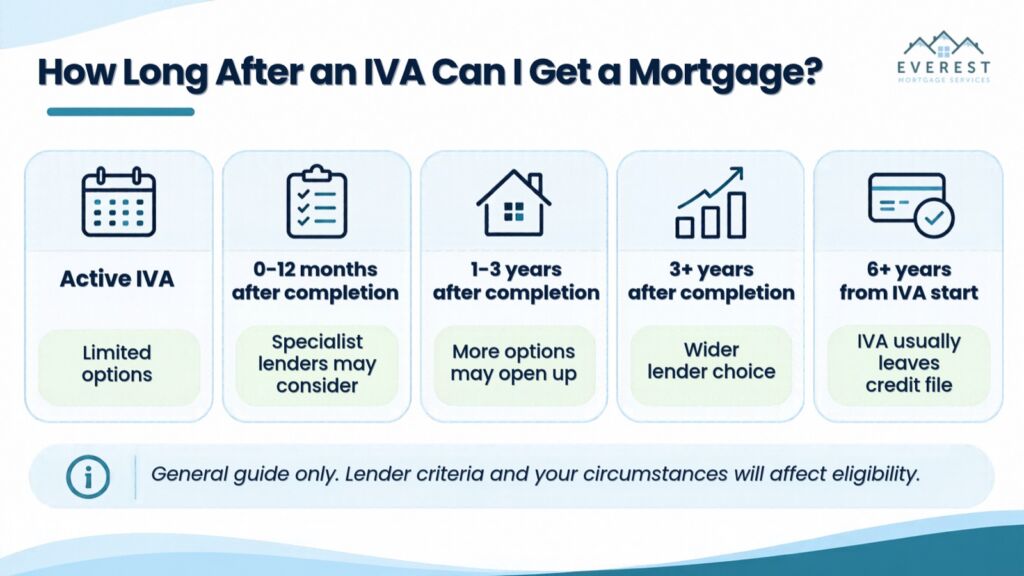
You may be able to get a mortgage before or after completing an IVA, but your options generally improve as more time passes. Lenders will consider your IVA status, credit history, deposit and affordability.
The table below gives a general guide. Each lender has its own criteria, so these timeframes are not guarantees of acceptance.
| Time since IVA | Potential lender options | Deposit considerations | Interest rates |
|---|---|---|---|
| During an active IVA | Very limited. Some specialist lenders may consider an application. | A larger deposit may be required. | Usually higher, if an offer is available. |
| 0–12 months after completion | Some specialist adverse credit lenders may consider you. | You may need a larger deposit. | Rates are likely to be less competitive. |
| 1–3 years after completion | More specialist options may become available, depending on your credit history. | Your deposit and overall circumstances will affect your options. | Rates may improve as more time passes. |
| 3+ years after completion | A wider range of lenders may consider your application. | A stronger deposit may help you access more options. | More competitive rates may be available. |
| 6+ years after the IVA start date | The IVA will usually have been removed from your credit file. Lenders will still assess your full circumstances. | Deposit requirements will depend on the lender. | You may have access to more competitive rates. |
A larger deposit, stable income and evidence of responsible credit use may help strengthen your application. Your eligibility and mortgage rate will always depend on the lender’s criteria and your individual circumstances.
How Long Does an IVA Stay on Your Credit File?
An Individual Voluntary Arrangement (IVA) usually stays on your credit file for six years from its start date, even if you complete it early. Credit reference agencies such as Experian, Equifax and TransUnion record this information, which lenders may review when assessing your mortgage application.
Credit File vs the Individual Insolvency Register
Your IVA is also recorded on the Individual Insolvency Register, maintained by the Insolvency Service. Unlike your credit file, the IVA is generally removed from the register around three months after completion.
Start Date vs Completion Date: What Lenders Look At
The six-year credit file period starts when your IVA begins, not when it is completed. If you settle your IVA early, it can still remain on your credit file until the six-year period has passed.
Lenders may consider both dates when assessing your mortgage application, as well as whether the IVA was successfully completed.
Your IVA Completion Certificate
Once you have fulfilled your IVA obligations, your Insolvency Practitioner should issue an IVA completion certificate confirming that the arrangement has ended.
Keep this document safe. You may need to provide it to Experian, Equifax and TransUnion to update your credit reports. If your IVA is incorrectly shown as active, contact the relevant credit reference agency and provide evidence of completion.
number of lenders, including…


How Much Deposit Do I Need for a Mortgage After an IVA?
The deposit required for a mortgage after an IVA depends on the lender, your credit history and how long ago the arrangement was completed. Some specialist adverse credit lenders may require a larger deposit to reduce their risk.
Your deposit is usually expressed as a percentage of the property’s value, known as the loan-to-value (LTV) ratio. A larger deposit means a lower LTV, which may give you access to more mortgage options and potentially better rates.
| Deposit size | Loan-to-value (LTV) | What it means |
|---|---|---|
| Smaller deposit | Higher LTV | You borrow a larger proportion of the property’s value, which may limit your lender options. |
| Larger deposit | Lower LTV | You borrow a smaller proportion of the property’s value, which may improve your choice of lenders and rates. |
A larger deposit may help, but it does not guarantee mortgage approval.
If you’re using a family gift towards your deposit, lenders will usually ask for proof of funds and confirmation that the money is a genuine gift rather than a loan. Understanding the requirements for a family gifted deposit mortgage can help you prepare the necessary documents before applying.
Which Lenders Accept Applicants with an IVA?
Some specialist adverse credit lenders and building societies may consider applicants with a completed IVA. High street lenders often have stricter criteria.
Your options will depend on when your IVA started, whether it has been completed, your deposit and affordability.
Should I Avoid Lenders That Were in My IVA?
Not necessarily. Having an IVA with a particular lender does not automatically mean they will reject a future application. Each lender has its own criteria and will assess your circumstances.
A specialist mortgage broker can help identify suitable lenders before you apply.
Will I Pay a Higher Interest Rate After an IVA?
You may face higher mortgage rates after an IVA, as lenders may view previous financial difficulties as a higher risk.
However, rates may become more competitive over time as you rebuild your credit history, maintain a stable income and save a larger deposit. You may also be able to remortgage onto a better rate later, subject to the lender’s criteria.
by the FCA
No lender ties
Joint Mortgages When One Partner Has an IVA
You can still apply for a joint mortgage if one partner has an IVA, but lenders will assess both applicants’ credit histories, income and affordability.
A sole mortgage application may be another option, depending on your circumstances. Our joint mortgage service explains how lenders assess applications when one applicant has a history of financial difficulties.
Right to Buy, Shared Ownership and Buy-to-Let After an IVA
An IVA does not automatically rule out Right to Buy, shared ownership or buy-to-let mortgages. However, eligibility depends on your IVA status, finances and the lender’s criteria.
Right to Buy allows eligible council tenants to purchase their home using a scheme discount. Shared ownership mortgages allow buyers to purchase a share of a property and pay rent on the remaining share.
For property investors, buy-to-let mortgages may also be an option. Lenders will assess your credit history, deposit, finances and expected rental income.
How to Improve Your Chances of Getting a Mortgage After an IVA
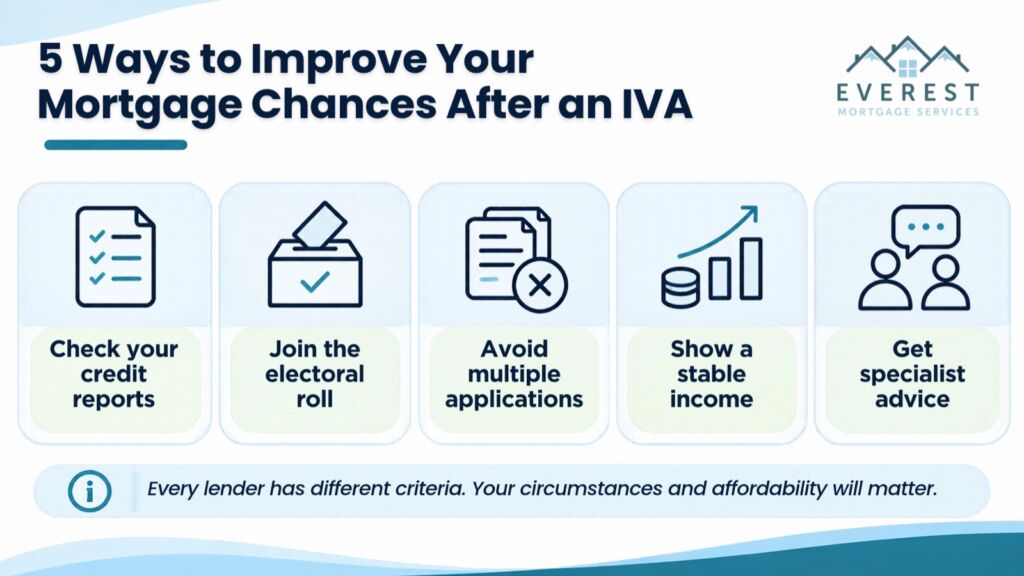
Rebuilding your financial profile can strengthen your mortgage application. Here are five practical steps:
- Check your credit reports: Review Experian, Equifax and TransUnion to make sure your IVA status and other details are accurate.
- Register on the electoral roll: This helps lenders verify your identity and address.
- Avoid multiple applications: Check lender criteria before applying to reduce unnecessary credit searches.
- Show a stable income: Consistent employment or reliable self-employed income can support your affordability assessment.
- Get specialist advice: A broker can help identify suitable lenders and avoid applications that are unlikely to succeed.
you borrow?
Whether you’re employed, self-employed, or a limited company director — get a realistic borrowing range in under 60 seconds. No personal details required.
Documents You’ll Need
When applying for a mortgage after an IVA, lenders may ask for documents to verify your identity, income, finances and deposit.
These may include:
- IVA completion certificate: Proof that your IVA has ended.
- Recent payslips: Usually your latest three months.
- Bank statements: Typically covering the last three to six months.
- P60 or SA302: Evidence of your annual income, particularly if you’re self-employed.
- Proof of deposit: Evidence showing where your deposit came from.
- Proof of address: Such as a recent utility bill or council tax statement.
Requirements vary between lenders, so check what you’ll need before applying.
Do I Have to Declare a Past IVA?
Yes. You must answer questions about previous IVAs honestly when applying for a mortgage. Some lenders ask whether you have ever had an IVA, even if it has been completed and removed from your credit file.
Always read the application questions carefully and provide accurate information. Failing to disclose an IVA when asked could be treated as misrepresentation or mortgage fraud.
Case Study: Helping a First-Time Buyer Secure a Mortgage Just Six Months After an IVA
The Challenge
A first-time buyer approached us looking to purchase their first home for £200,000, having completed an Individual Voluntary Arrangement (IVA) just six months earlier.
Although their financial circumstances had improved, the recent completion of their IVA meant their mortgage options were limited.
The client’s dream was to own their own property, stop renting and finally get onto the property ladder.
Our Approach
Having reviewed the client’s credit history, income and overall financial circumstances, I approached several specialist mortgage lenders to discuss the case.
One of the key benefits was that the client had a strong enough deposit to help support the case.
- Purchase price: £200,000
- Deposit: £30,000 (15%)
- Mortgage required: £170,000
- Time since IVA completion: Six months
I spoke directly with mortgage underwriters to discuss the reasons behind the IVA, how the client had maintained their payments throughout the arrangement and how their financial circumstances had improved.
The combination of a strong deposit, successfully maintaining and completing the IVA, and my explanation of their current circumstances helped support the lender’s decision.
The Outcome
We successfully secured a £170,000 mortgage through a specialist lender, allowing the client to purchase their first home for £200,000.
The client was extremely happy with the outcome. Owning their own property was something they had wanted to achieve for a long time, and they were finally able to stop renting and fulfil their dream of becoming a homeowner.
Broker Insight – John Everest, Director of Everest Mortgages
Having an IVA on your credit history does not necessarily mean you need to wait several years before applying for a mortgage.
In this particular case, the deposit size was strong enough to help support the additional lending risk. It was also important that I could speak directly with underwriters and explain the client’s overall circumstances, rather than simply allowing their credit history to determine the outcome.
Every lender has different criteria, and every client’s circumstances are different. Understanding which lenders to approach and how to present a case can make a significant difference.
Looking for a Mortgage After an IVA?
If you’ve previously had an IVA and are unsure whether you could qualify for a mortgage, book in to discuss your circumstances with one of our specialist mortgage advisers. We can help you understand what options may be available.
All mortgages are subject to lender criteria, affordability assessments and individual circumstances.
Your home may be repossessed if you do not keep up repayments on your mortgage.
- Totally impartial — we work for you, not the lender
- Whole-of-market access to thousands of deals
- Flexible appointments — evenings & weekends available
- We handle all the paperwork & lender negotiations
- FCA regulated — your advice is always protected
perfect mortgage?
Get in touch for a free, no-obligation consultation with one of our expert advisers. We’ll do all the hard work for you.
Get in TouchSpeak to an IVA Mortgage Broker in Brighton
Having an IVA or bankruptcy does not automatically mean you cannot get a mortgage. The right advice can help you understand your options based on your circumstances.
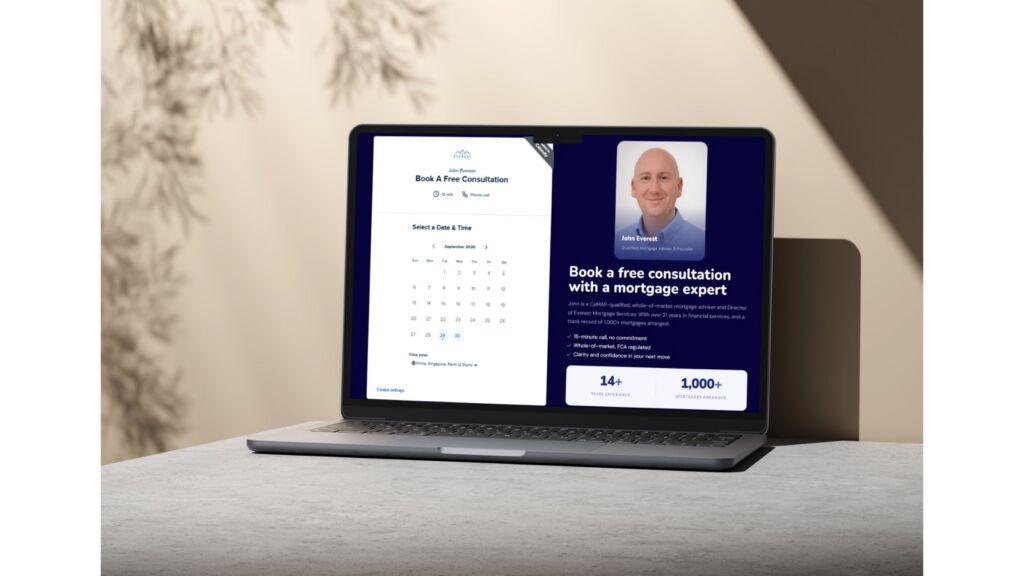
At Everest Mortgages, we can review your financial situation, discuss suitable lenders and guide you through the application process. Book a free 15-minute call to discuss your options.
If you’re looking for support with an IVA or bankruptcy mortgage, our specialist mortgage service can help you take the next step.
Frequently Asked Questions
Can I get a mortgage with an active IVA?
It can be difficult, as most lenders prefer applicants who have completed their IVA. However, some specialist lenders may consider applications depending on your circumstances and the terms of your arrangement.
Can I get a mortgage immediately after completing an IVA?
Potentially, yes. Some specialist lenders may consider applications shortly after completion, although you may need a larger deposit and face higher interest rates.
Can I get a mortgage six years after an IVA?
Yes. An IVA usually drops off your credit file six years after its start date. However, lenders may still ask about previous insolvency arrangements, so you must answer application questions honestly.
Can I get a mortgage after bankruptcy?
Yes, it may be possible after bankruptcy, but eligibility depends on when you were discharged, your credit history, deposit and individual lender criteria.
Do I need a specialist mortgage broker after an IVA?
A specialist broker can help identify lenders that consider applicants with previous IVAs, assess your eligibility and avoid unnecessary mortgage applications.
Can I get a joint mortgage if my partner has an IVA?
Potentially. Lenders will assess both applicants’ credit histories, income and affordability. A sole application may also be worth considering, depending on your circumstances.
Will an IVA affect my chances of remortgaging?
An IVA can limit your remortgage options, particularly while it is active. Once completed, more lenders may consider your application depending on your credit history, equity and affordability.