Quick Answer
A remortgage usually means moving your mortgage to a new lender, while a product transfer means switching to a new deal with your current lender. A product transfer may be quicker and simpler, but a remortgage may offer wider choice and potentially better options depending on your circumstances.
Remortgage or Product Transfer: Which Makes More Sense?
When a fixed-rate mortgage is coming to an end, many homeowners across Brighton, Hove, Worthing, Shoreham, Lewes and wider Sussex face the same question: should you stay with your current lender or move to a new one? The difference can affect your monthly payments, borrowing flexibility, fees, affordability checks and long-term plans.
A product transfer means taking a new deal with your existing lender. It is often quicker, may involve fewer checks and can feel like the simplest option if your circumstances have changed recently.
A remortgage, on the other hand, usually means moving to a new lender to access a wider range of rates, products and borrowing options. Depending on your income, property value, loan-to-value and future plans, one route may be more suitable than the other.
The challenge is that the easiest option is not always the cheapest or most flexible. Some homeowners automatically accept a product transfer offer without comparing the wider market, while others remortgage unnecessarily and take on extra costs or checks they may not need.
Understanding the difference before your current deal ends can help you avoid rolling onto your lender’s Standard Variable Rate (SVR), which is often significantly more expensive.
The right option depends on rate, fees, affordability, flexibility and your future plans. A whole-of-market mortgage broker can help compare your options before you apply.
Your home may be repossessed if you do not keep up repayments on your mortgage.
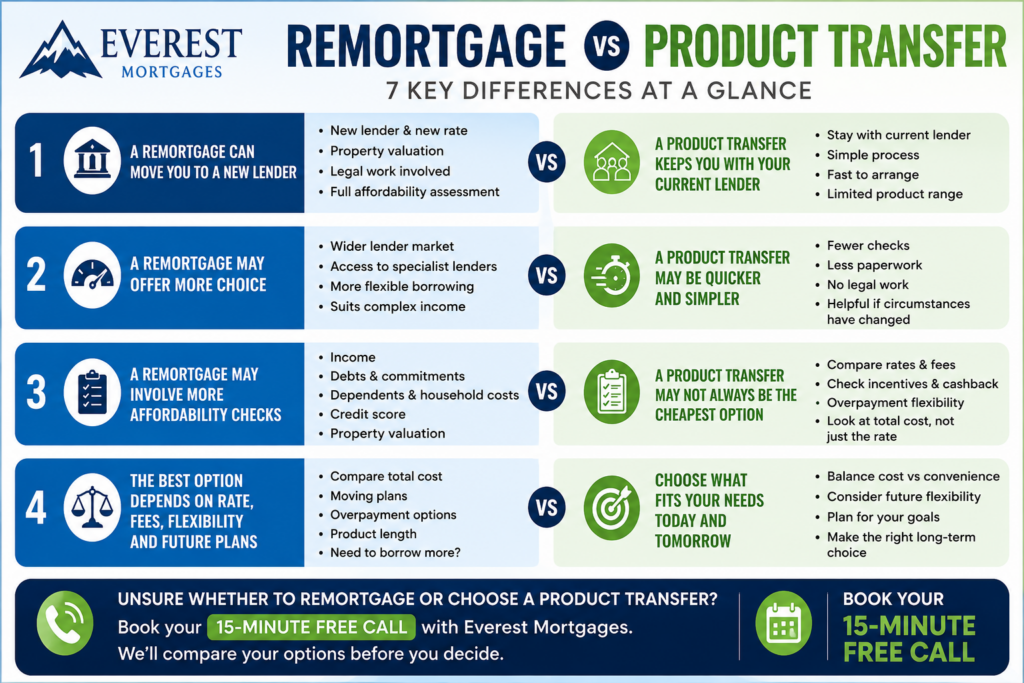
1. A Remortgage Can Move You to a New Lender
A remortgage allows you to replace your existing mortgage with a new deal from another lender. This gives you the opportunity to compare rates, product features and lender criteria across the wider market rather than relying on a single lender’s renewal offer.
For some homeowners in Brighton, Hove, Worthing and across Sussex, this may create access to more competitive fixed rates or lenders that better suit their long-term plans.
Because you are applying to a completely new lender, the process is treated as a new mortgage application. The lender will usually assess your income, credit profile, monthly commitments and current property value before making an offer. Legal work is also normally required to transfer the mortgage between lenders, although some remortgage products may include free valuations or free legal services. Remortgages typically take around 4–8 weeks to complete.
A remortgage can also be useful if your current lender’s rates, criteria or mortgage features no longer fit your needs. However, moving lender involves more administration and underwriting than staying where you are.
today
Find out how much you could borrow in minutes. No credit check, no commitment – just clear, honest mortgage advice.
2. A Product Transfer Keeps You with Your Current Lender
A product transfer means switching to a new mortgage deal with your existing lender instead of moving elsewhere. Your mortgage balance and lender remain the same, but the interest rate and product terms change once your current deal ends.
Many homeowners choose this route because it is more straightforward than a full remortgage. In most standard product transfers:
- there is no solicitor involved
- legal work is avoided
- a new valuation is often unnecessary
- the process can often be completed online
Some lenders can complete product transfers within days, making them attractive for borrowers approaching the end of a fixed-rate deal.
The trade-off is that you are restricted to the products offered by your current lender. You are not comparing rates or mortgage features from the wider market, which means alternative lenders may still offer better overall value depending on fees, flexibility and loan-to-value.

with a mortgage expert
- 15-minute call, no commitment
- Whole-of-market, FCA regulated
- Clarity and confidence in your next move
3. A Remortgage May Offer More Choice
One advantage of remortgaging is flexibility around more complex borrowing situations. Different lenders assess applications in very different ways. Some may be more comfortable with:
- self-employed income
- company directors
- multiple income streams
- bonus or commission-based earnings
- borrowing into retirement
- recent credit issues
This can matter for homeowners whose circumstances have changed since taking out their original mortgage. A remortgage may also provide more flexibility if you want to borrow additional funds for:
- home improvements
- extending your property
- releasing equity
- consolidating debts
- helping family financially
Some lenders are significantly more flexible than others when assessing additional borrowing requests or higher loan-to-value applications.
This is where a whole-of-market broker like Everest Mortgages can add value by comparing lender criteria as well as rates.
number of lenders, including…


4. A Product Transfer May Be Quicker and Simpler
A product transfer is often chosen for convenience rather than flexibility. Because the lender already holds your mortgage and repayment history, the process may involve very little paperwork. Many straightforward product transfers can be arranged online in minutes without lengthy underwriting or document checks.
This can be particularly useful if your circumstances have changed since you originally took out the mortgage. For example:
- your income has reduced
- you recently changed jobs
- you became self-employed
- household spending has increased
- your credit profile is weaker than before
In many like-for-like product transfers where the borrowing amount and mortgage term stay the same, lenders may not carry out full affordability checks again.
For homeowners worried about passing a new lender’s affordability assessment, staying with the current lender may therefore feel less stressful and easier to arrange before the existing fixed rate expires.
by the FCA
No lender ties


5. A Remortgage May Involve More Affordability Checks
A remortgage usually involves a full reassessment of your finances because you are applying to a new lender. Even if you have managed your existing mortgage well for years, the new lender will still review whether the mortgage remains affordable under current lending rules.
Lenders Look Beyond Salary Alone
Affordability is no longer based purely on income multiples. Most lenders now assess:
- regular monthly spending
- existing debts and credit commitments
- childcare and dependants’ costs
- household bills
- credit history
- future affordability if interest rates rise
In 2026, most mainstream UK lenders typically lend around 4–4.5 times household income, although some specialist products may stretch higher depending on circumstances (Mortgage Notes, April 2026).
For example, a household in Hove earning £70,000 jointly may theoretically qualify for borrowing around £315,000 at 4.5x income, but higher credit card balances, car finance or childcare costs could reduce the final amount offered.
Property Value Can Also Affect Your Options
When remortgaging, the lender will normally reassess your property value to calculate your loan-to-value (LTV). If your property value has increased since you took out the mortgage, you may qualify for lower-rate products. However, if the valuation comes back lower than expected, rates and lender choice may become more restricted.
This can be particularly important in areas such as Brighton and Lewes where property values can vary significantly between locations and property types.
Why This Matters for Product Transfers
Some homeowners approaching the end of a fixed-rate deal choose a product transfer specifically to avoid a full affordability reassessment. This is often relevant where:
- income has reduced
- a borrower recently became self-employed
- household costs increased
- a new dependant arrived
- credit commitments are higher than before
Discussions from UK homeowners in 2025–2026 regularly show borrowers using product transfers to avoid the uncertainty of a new lender affordability assessment after changes in income or family circumstances.
you borrow?
Whether you’re employed, self-employed, or a limited company director — get a realistic borrowing range in under 60 seconds. No personal details required.
6. A Product Transfer May Not Always Be the Cheapest Option
A product transfer can look attractive because the process is simple, but the lowest-stress option is not always the lowest-cost option over the full mortgage term.
The Headline Rate Does Not Tell the Full Story
Many borrowers focus only on the interest rate offered by their current lender. However, the total cost of a mortgage deal can also include:
- arrangement fees
- cashback incentives
- valuation costs
- legal fees
- overpayment flexibility
- ERCs (early repayment charges)
In April 2026, some UK comparisons showed product transfer rates averaging around 0.15%–0.30% higher than equivalent open-market remortgage deals. On a £200,000 mortgage, that difference could equate to roughly £2,000 over a five-year fixed term depending on fees and repayment structure (Mortgage Notes, April 2026).
Fee-Free Does Not Always Mean Better Value
A fee-free product transfer may still cost more long term if the interest rate is noticeably higher. Equally, some remortgage deals include incentives such as free legal work, free valuations, and cashback offers between £250–£500.
On larger mortgage balances in places like Brighton or Hove, even a slightly lower rate can outweigh upfront fees over several years.





7. The Best Option Depends on Rate, Fees, Flexibility and Future Plans
There is no universal answer to whether a remortgage or product transfer is better. The right option depends on how the overall deal fits your finances over the next few years, not just the headline interest rate.
For some homeowners in Brighton, Hove, Worthing and across Sussex, a product transfer may offer enough certainty and convenience to justify staying put. For others, remortgaging may create better long-term value through lower rates, improved flexibility or access to borrowing options their current lender cannot offer.
Compare the Total Cost, Not Just the Rate
A lower rate does not automatically mean a cheaper mortgage overall. The real comparison should include:
- arrangement fees
- cashback incentives
- legal costs
- valuation fees
- ERCs (early repayment charges)
- monthly repayments over the fixed term
Research published in April 2026 showed open-market remortgage deals were often around 0.15%–0.30% cheaper than equivalent product transfers, particularly above 80% loan-to-value. On larger mortgage balances, even small rate differences can compound significantly over a 2- or 5-year fix.
Think About Future Flexibility
The cheapest product today may not be the most suitable option later. Before choosing either route, many homeowners review:
- whether they plan to move home soon
- if they may need to borrow more later
- overpayment flexibility
- whether the mortgage is portable
- how long they want payment certainty for
- future retirement or income plans
For example, someone planning major home improvements in Shoreham or Lewes within the next two years may value flexible borrowing options more than the absolute lowest fixed rate available today.
Timing Matters Too
Millions of fixed-rate mortgages are ending across the UK during 2026, increasing competition between lenders but also increasing the risk of borrowers drifting onto expensive Standard Variable Rates (SVRs).
Many brokers recommend reviewing options around 4–6 months before your current deal expires so there is time to compare both product transfer and remortgage routes properly.
- Totally impartial — we work for you, not the lender
- Whole-of-market access to thousands of deals
- Flexible appointments — evenings & weekends available
- We handle all the paperwork & lender negotiations
- FCA regulated — your advice is always protected
perfect mortgage?
Get in touch for a free, no-obligation consultation with one of our expert advisers. We’ll do all the hard work for you.
Get in TouchRemortgage vs Product Transfer – Comparison Table
| Feature | Remortgage | Product Transfer |
| Lender | Move to a new lender | Stay with your current lender |
| Choice of Deals | Access to wider market and specialist lenders | Limited to your current lender’s products |
| Speed | Usually takes longer due to underwriting and legal work | Often quicker and simpler to arrange |
| Affordability Checks | Usually full affordability and credit assessment | Often lighter checks for like-for-like switches |
| Legal Work | Typically requires solicitor involvement | Usually no legal work required |
| Property Valuation | Commonly required by new lender | Often not needed |
| Borrowing More | May provide more flexible additional borrowing options | Depends on current lender’s criteria |
| Fees & Incentives | May include arrangement fees, cashback or free legals | Often lower upfront costs but fewer incentives |
| Best Use Case | Suitable when comparing rates, releasing equity or needing flexibility | Suitable when prioritising speed, simplicity and minimal paperwork |
When to Choose a Remortgage
A remortgage is often more suitable when flexibility, borrowing options or long-term savings matter more than speed alone.
1. When Your Current Lender’s Rates Are Uncompetitive
Some lenders offer strong product transfer rates, while others rely on convenience to retain existing customers. Comparing the wider market may reveal lower rates or better mortgage features elsewhere.
In May 2026, average open-market remortgage rates at some loan-to-value bands were lower than equivalent product transfer rates, particularly at higher LTVs.
This can become more important on larger mortgages where even a 0.20% rate difference may affect repayments by thousands of pounds over a fixed term.
2. When You Want to Release Equity
Remortgaging may allow you to borrow additional funds against your property value, subject to affordability and lender criteria. Homeowners across Brighton and Hove commonly use remortgaging to:
- fund extensions or renovations
- modernise older properties
- support education costs
- help family members financially
- cover major life expenses
If your property value has increased, your loan-to-value ratio may improve, potentially unlocking more competitive rates.
3. When You Need More Flexible Lending Criteria
Different lenders assess borrowers differently. A remortgage may open access to lenders more comfortable with:
- self-employed income
- company directors
- multiple income streams
- approaching retirement
- historic credit issues
This is where a whole-of-market mortgage broker can add value by comparing lender criteria, not just rates.
4. When You Want to Consolidate Debt Carefully
Some homeowners remortgage to consolidate unsecured borrowing such as loans or credit cards into one monthly mortgage payment. This may reduce monthly outgoings, although the debt is then secured against the property.
Consolidating unsecured debt into your mortgage may reduce monthly payments, but it can increase the total amount repaid over the full mortgage term.
Example Scenario: When Remortgaging May Save More
A homeowner in Worthing has:
- £260,000 remaining mortgage
- 65% loan-to-value
- 20 years remaining
Their current lender offers:
- 5-year product transfer at 4.95%
- £999 arrangement fee
A competing lender offers:
- 5-year remortgage at 4.62%
- free legal work
- free valuation
- £300 cashback
Despite the extra underwriting involved, the lower rate reduces repayments by roughly £50–£60 per month. Over five years, the estimated saving could exceed £3,000 depending on repayment structure and fees. (Illustrative example only.)
Your home may be repossessed if you do not keep up repayments on your mortgage.
When to Choose a Product Transfer
A product transfer is often chosen when simplicity, speed and minimal disruption matter more than accessing the full mortgage market.
1. When You Need a Faster Solution
If your fixed-rate mortgage is ending soon, a product transfer can often be completed much faster than a remortgage because the lender already holds your mortgage details and repayment history. In many cases, there is no solicitor involved, very little paperwork and fewer underwriting checks, allowing some lenders to switch the deal within days. This can help homeowners secure a new rate quickly and avoid rolling onto a higher Standard Variable Rate (SVR).
2. When Your Circumstances Have Changed
Some homeowners choose product transfers because they are concerned about passing a new lender’s affordability assessment. This may apply if:
- income has fallen
- household spending increased
- employment changed recently
- you became self-employed
- your credit profile weakened
Many like-for-like product transfers do not require full affordability reassessment if the borrowing amount stays unchanged.
3. When the Costs of Moving Lender Outweigh the Benefit
A remortgage can involve additional costs such as arrangement fees, solicitor fees, valuation charges and, in some cases, broker fees depending on the service used. While many lenders offer incentives like free legal work, free valuations or cashback, the savings from switching lender may be limited on smaller mortgage balances if the new rate is only slightly lower than your current lender’s product transfer
For borrowers with lower balances or shorter remaining mortgage terms, the convenience of staying put may outweigh potential savings elsewhere.
Fee Comparison Snapshot
| Cost Type | Product Transfer | Remortgage |
| Legal fees | Usually none | Often free, sometimes £300–£500 |
| Valuation fee | Usually none | Often included |
| Arrangement fee | £0–£999 common | £0–£999 common |
| Cashback incentives | Less common | Often £250–£500 |
| Affordability checks | Usually lighter | Usually full assessment |
| Completion time | Days to weeks | Typically 4–8 weeks |
Example Scenario: When a Product Transfer May Make More Sense
A homeowner in Lewes has:
- £110,000 remaining mortgage
- 8 years left on the term
- recent move to self-employment
Their lender offers:
- 2-year product transfer at 4.78%
- no fees
- immediate switch process
An open-market remortgage is available at:
- 4.55%
- £999 arrangement fee
- full affordability checks required
Although the remortgage rate is lower, the overall saving after fees is limited due to the smaller mortgage balance and shorter remaining term. The borrower chooses the product transfer to avoid delays and additional underwriting. (Illustrative example only.)
Need Help Choosing Between a Remortgage or a Product Transfer?
If your mortgage deal is ending soon, Everest Mortgages can help you compare remortgage and product transfer options based on rates, fees, flexibility and your future plans. We support homeowners across Brighton, Hove, Worthing, Shoreham, Lewes and wider Sussex with whole-of-market mortgage advice tailored to their circumstances.
Book your free 15-minute call with Everest Mortgages before committing to a new deal.
FAQs
1. Is a product transfer the same as a remortgage?
No. A product transfer means switching to a new deal with your current lender, while a remortgage usually involves moving your mortgage to a new lender. A remortgage may offer wider choice, while a product transfer is often quicker and simpler.
2. Which is better: a remortgage or a product transfer?
The better option depends on your rate, fees, borrowing needs, affordability and future plans. Some homeowners benefit from the simplicity of a product transfer, while others may find better value by comparing the wider mortgage market through a remortgage.
3. Do product transfers involve affordability checks?
Some lenders carry out lighter affordability checks for like-for-like product transfers, especially if you are not borrowing more or changing the mortgage term. Requirements vary between lenders and circumstances.
4. Can I borrow more with a product transfer?
Some lenders allow additional borrowing alongside a product transfer, although the options may be more limited compared to a remortgage. Additional borrowing is usually subject to affordability and lender criteria.
5. Do I need a mortgage broker for a product transfer or remortgage?
You are not required to use a broker, but a whole-of-market mortgage broker can help compare rates, fees, lender criteria and long-term costs before you choose between a remortgage and a product transfer.