Quick Answer: Getting a Mortgage with No Deposit in Worthing
Getting a mortgage with no deposit in Worthing is possible, but options are limited and strict criteria apply. Some lenders may offer 100% LTV mortgages, while others allow guarantor or family-assisted schemes. Approval usually depends on strong credit, stable income, and affordability checks. Availability varies by lender and market conditions.
Introduction
Worthing sits within Worthing Borough Council, and popular residential areas include Goring-by-Sea, Broadwater, and West Tarring. Many buyers look in postcodes such as BN11, BN12, and BN14, which contain a mix of seaside flats, Victorian terraces, and family semi-detached homes.
It is possible to get a mortgage with no deposit in Worthing, but options are limited and criteria are strict. With average home prices in Worthing around £308,000 according to the UK House Price Index (ONS / HM Land Registry, Dec 2025), saving a deposit can feel difficult for many buyers.

Many renters struggle to save a typical 10% deposit of about £30,800, especially while paying rent. However, this is illustrative and may vary by lender and property type.
The average private rent in Worthing is around £1,306 per month (ONS Private Rental Market Statistics, Dec 2025), meaning a large portion of income often goes towards housing rather than saving.
Worthing remains relatively affordable compared with parts of the South East. While the South East average house price was about £379,000 in Dec 2025, the average in Worthing was around £309,000, making it a popular location for first-time buyers moving from nearby Brighton or London commuter areas. Property prices and lending criteria change regularly, so figures are illustrative and based on the latest available data at the time of writing.
What Exactly Is a ‘No Deposit’ Mortgage?
A no deposit mortgage means you do not put down your own cash as a deposit. In simple words, you borrow 100% of the property price. This is called a 100% Loan-to-Value (LTV) mortgage.
But it does not always mean there is zero security. Some deals use a guarantor. Some schemes use family savings as security, meaning you may not need to provide a cash deposit yourself. However, the lender still has financial protection through the guarantor’s savings. This arrangement varies by lender and is always subject to affordability checks and lending criteria.
With a normal mortgage, you usually need 5% to 20% of the property price as a deposit. With a true 100% mortgage, you borrow the full amount. Other “no deposit” options reduce your upfront cost but involve family support or savings linked to the mortgage.
Types of No Deposit and Low Deposit Mortgages for Worthing Buyers
If you want to buy in Worthing without a big deposit, you have a few possible options. Not all of them are true ‘zero deposit’ deals. In many cases, you are not putting down your own cash, but someone else is helping or providing security. It is important to understand the difference before you apply.
Always check how the lender is reducing the risk if you are not putting in a deposit yourself.
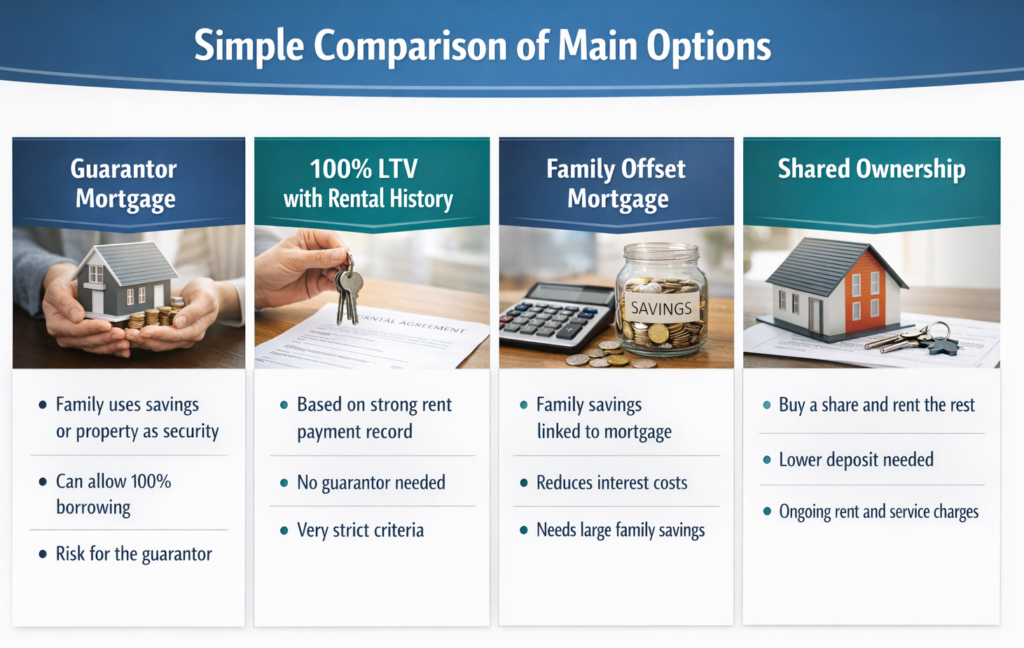
1. Guarantor Mortgages
With a guarantor mortgage, a family member, usually a parent, supports your application by providing additional security. This may involve using their savings or, in some cases, a charge against their own property. In certain circumstances, this arrangement can allow you to borrow up to 100% of the property value, although the exact loan amount will vary by lender and is subject to affordability assessments and lending criteria.
One potential benefit is that lenders may offer more competitive interest rates compared with some other no-deposit options. Having a guarantor can also strengthen your application and improve your chances of approval.
However, it is important to understand the risks involved. If you are unable to keep up with the mortgage repayments, the guarantor may become legally responsible for covering the debt. This means their savings or property could be at risk, which can also place strain on family relationships.
For this reason, guarantors should always seek independent financial and legal advice before committing, as acting as a guarantor is a significant financial responsibility.
2. 100% LTV Mortgages Based on Rental History
Some lenders may offer 100% loan-to-value mortgages, although availability is limited and approval depends on affordability checks and lender criteria. This means you have paid your rent on time for a long period.
The benefit is simple. You do not need a guarantor. You can move straight to full ownership.
The catch is that the rules are strict. You usually need a clean credit record, steady income, and proof of consistent rent payments. These products are not widely available.
3. Family Offset Mortgages
With this option, a family member puts savings into a linked account. The money stays in their name. It is not given to you as a deposit.
The savings reduce the interest charged on your mortgage. This can lower your monthly payments or shorten the mortgage term.
The good part is that the family savings are still accessible after a set period. The downside is that your family needs a large amount of savings to make it work. These mortgages are also less common.
4. Shared Ownership
Shared Ownership is a government backed scheme. You buy a share of a property, for example 25% to 75%, and pay rent on the rest to a housing association. On a £308,000 property, buying a 50% share would cost £154,000, with rent payable on the remaining £154,000.
In Worthing, shared ownership homes are often available through local housing associations and new developments around Durrington, Goring-by-Sea, and West Worthing, where flats and smaller terraced homes are common starter properties.
The main benefit is a lower deposit and smaller mortgage. It can be a stepping stone to full ownership over time.
But you will still pay rent on the remaining share. There can also be service charges. If you want to buy more shares later, called staircasing, there are extra costs. Property choice can also be limited.
Mortgage products change often. Lenders update their criteria regularly. Always check the latest details before making a decision.
Eligibility Criteria to Get a Mortgage with No Deposit?
If you are asking, how can I get a mortgage with no deposit, the first thing lenders check is whether you actually qualify. No deposit does not mean no rules. In fact, the checks are usually stricter.
These are the main things lenders check before approving your application.
1. Your Income and Job
You must show steady and reliable income. Lenders carefully check your earnings and job history.
- If you are employed, they usually want at least 3 to 6 months of payslips and proof of continuous employment.
- If you are self-employed, they generally ask for 1 to 2 years of accounts.
- They check how long you have been in your job to ensure stability.
Lenders also calculate how much you can borrow using income multiples. For example, if a buyer wanted to purchase a home worth around £308,000 (ONS, Dec 2025), some lenders using a 4–5x income multiple might expect household income of roughly £60,000–£77,000. However, the exact income requirement varies by lender and affordability criteria.
2. Your Credit Score
When you apply for a mortgage with no deposit, your credit profile plays a major role in the decision. Lenders carefully review your past borrowing behaviour to see how reliable you are with money. They want to see a clean record with no recent defaults, no CCJs, no bankruptcies, and no missed payments. The stronger and cleaner your credit file is, the lower the risk you appear to the lender, which improves your chances of approval.
To improve your credit score before applying:
- Register on the electoral roll
- Pay all bills on time
- Keep credit card balances low
- Check your credit report for errors
You can check your credit score with services like Experian, Equifax, or ClearScore. Always review your report before applying.
3. Your Debts and Monthly Commitments
Lenders look at your debt to income ratio. This means how much of your income goes towards loans, credit cards, car finance, or other debts.
If you already have high monthly payments, your chances of getting a mortgage with no deposit are lower. They also stress test your mortgage. This means they check if you could still afford payments if interest rates go up.
To improve your affordability, you need to show that you manage your money carefully. Start by cutting down on unnecessary spending and avoiding regular use of your overdraft, as this can signal financial pressure.
Focus on paying down existing debts to reduce your monthly commitments. It also helps to save small amounts consistently, even if the amount is modest, because this shows lenders that you are financially disciplined and capable of managing regular payments responsibly.
You can use budgeting tools like YNAB or Monzo to manage your money better and track spending.
Extra Checks for No Deposit Options
If you are applying for a specific type of no deposit mortgage, there are extra requirements.
If You Are Using a Guarantor
The guarantor must:
- Have strong income
- Have good credit
- Own property or have savings
- Be willing to take legal responsibility
They should always get independent legal and financial advice before agreeing. Their money or home could be at risk.
If You Are Applying for a 100% Mortgage Based on Rent
You usually need:
- At least 12 to 24 months of rental history
- Proof that you paid rent on time
- A clean credit record
Lenders want to see that your rent payments are similar to what your mortgage payments would be.
If You Are Using Shared Ownership
There may be:
- Income limits
- Rules about household size
- Restrictions on property type
- First time buyer requirements
Each scheme has its own criteria, so always check the latest details.
The Step by Step Process for Getting a No Deposit Mortgage
If you are serious about how can I get a mortgage with no deposit, you need to understand the full process. It is not quick, and preparation is very important.
Phase 1: Get Yourself Ready
Start with your credit report. Check your file with all three main agencies in the UK. These are Experian, Equifax, and TransUnion.
Look for mistakes and fix any errors straight away. Make sure you are registered on the electoral roll. Work on improving your score before applying, not after.
Next, understand your money clearly. Know your income. Know your monthly spending. Be honest about your debts and regular bills. You can use online mortgage affordability calculators from major UK lenders to get a rough idea of what you might borrow.
Also, prepare your documents early. Most lenders will ask for proof of ID, proof of address, payslips or self-employed accounts, bank statements, and sometimes your credit reports. Having everything ready makes the process smoother and faster.
Phase 2: Speak to a Professional
For no deposit mortgages, speaking to an experienced broker is very important. These cases are more complex than normal applications.
A good broker can access niche products, explain which option suits you, and present your case properly to the lender. They also understand which lenders are more flexible with 100% or guarantor mortgages.
Before choosing a broker, make sure they are properly authorised. You can check this on the Financial Conduct Authority register. This confirms they are regulated and legitimate.
During this stage, you will discuss your income, credit score, debts, and possible support from family. If everything looks good, the broker will help you get an Agreement in Principle (AIP).
An Agreement in Principle (AIP) is a statement from a lender saying they are willing to lend you a certain amount, based on initial checks. It is not a full approval, but it shows estate agents that you are serious and financially ready.
Phase 3: Apply and Complete
Once you have your Agreement in Principle (AIP), you can start searching for properties within your budget. In Worthing, first-time buyers often focus on flats and maisonettes, which averaged around £188,000 in Dec 2025 according to Land Registry data. (ONS, Dec 2025)
Some no-deposit schemes may have restrictions on property type or price, so it’s important to check before making an offer.
Once a home is agreed upon, your full mortgage application is submitted through your broker, and the lender begins their detailed review. At the same time, a conveyancer or solicitor handles all legal aspects, ensuring the transfer is smooth.
Key Steps to Completion
- Property valuation: The lender confirms the property’s market value.
- Underwriting checks: Lender reviews income, credit, and submitted documents.
- Legal work: Conveyancer manages contracts, searches, and ownership transfer.
- Formal mortgage offer: Issued once all checks are complete.
- Exchange of contracts: Legally binding stage of the purchase.
- Completion and keys: Funds are transferred, and you officially become a homeowner.
Costs You Still Pay with a No-Deposit Mortgage (UK Average Costs, 2025–2026)
Table 1. Compiled from Compare My Move, EveryCalc, and HomeMove (UK, Dec 2025 – Jan 2026)
| Cost Type | Typical Range (UK 2025–2026) |
| Solicitor / Conveyancing Fees | £1,000–£2,500+ (average ~£1,575) |
| Valuation / Survey Fees | £300–£1,500+ (depending on survey level) |
| Mortgage Arrangement / Booking Fees | £0–£2,000+ (varies by lender) |
| Stamp Duty Land Tax (SDLT) | £0–£15,000+ depending on price & buyer status |
| Land Registry & Search Fees | £150–£650+ |
| Moving Costs (Removals / Van Hire / Insurance) | £300–£2,000+ |
A no-deposit mortgage only removes the traditional cash deposit requirement. It doesn’t eliminate these essential costs that every buyer faces. Budgeting for them early can prevent last-minute money stress and give you a clearer picture of the total amount you need before completion.
Take the Next Step Towards Homeownership
If you’re serious about buying in Worthing without a deposit, now is the time to check your options. See if you meet the key criteria, understand which products suit your situation, and discover the routes that could get you on the property ladder sooner. Find out if you qualify for a no-deposit mortgage in Worthing today and take the first step toward your new home.
FAQs About No-Deposit Mortgages in Worthing
1. Do 100% LTV mortgages still exist in the UK?
Yes, but they are limited. You usually need a strong rental history or a guarantor to qualify. Not all lenders offer these products, and criteria can vary widely between lenders.
2. What other costs should I budget for besides the deposit?
Even with no deposit, you still need money for stamp duty (if applicable), solicitor fees, valuation fees, mortgage arrangement fees, moving costs, and any repairs or furnishings.
3. Can I get a no-deposit mortgage if I’m self-employed in Worthing?
Yes, it may be possible. Most lenders will expect at least 2–3 years of SA302s, tax year overviews, and business accounts to verify your income. Approval will depend on affordability assessments, credit history, and the lender’s specific criteria.
4. Are there specific schemes for key workers in Worthing?
Some national schemes like Shared Ownership exist, and local councils may run their own initiatives. Check the Worthing Borough Council website for details.
5. How long does the process take?
It usually takes 3–6 months from application to completion, depending on the lender, mortgage type, and conveyancing process.