Getting a mortgage is a big step, but if you’re self-employed in Brighton & Hove, it can feel more complicated than it should. Without a regular payslip, many freelancers, contractors, and business owners find that high-street advice doesn’t quite fit their situation, especially when income changes year to year, and property prices are anything but simple.
That’s why we at Everest Mortgages created this guide to make self-employed mortgage applications clearer and simpler. You’ll learn what lenders usually look for, how to present your income in the best light, and how local, specialist advice can make the process far smoother when you’re ready to buy.
Self-Employed Mortgages in Brighton & Hove
If you’re self-employed, applying for a mortgage can feel a bit different and sometimes more complicated than it does for someone on a regular salary. Most lenders still prefer neat, predictable payslips, which is why self-employed income is often scrutinised more closely.
Instead of monthly payslips or a P60, lenders rely on information like your self-assessment returns, accounts and overall income history. If your earnings fluctuate from year to year, proving stability can feel frustrating, even when your business is doing well.
That’s especially true in Brighton & Hove, where many people work for themselves, from freelancers and creatives to tradespeople and business owners. At Everest Mortgages, we’ve helped many self-employed clients clearly demonstrate their income to lenders. Understanding how lenders view self-employed earnings is the first step to putting together a realistic application that gives you the best chance of approval.
What Counts as ‘Self-Employed’ for Mortgage Lenders?
When lenders say self-employed, they don’t just mean one type of work. How you run your business plays a big role in how your income is assessed, so it’s important to know where you fit.
Sole Traders
Solo traders usually calculate their income from net profit, not turnover. Lenders look at your Self Assessment records, mainly SA302s and Tax Year Overviews, alongside business and personal bank statements to see how consistent your earnings are.
Limited Company Directors
These company directors are assessed a bit differently. Most lenders focus on your salary plus dividends, although some specialist lenders may also take retained profits into account. Expect to provide company accounts, SA302s and dividend vouchers to support your figures.
Contractors and Freelancers
Contractors and freelancers are often assessed on day rates and contract length rather than yearly profits. Whether you work through an umbrella company or contract directly can affect which lenders are suitable for you. Contracts, recent invoices, and bank statements usually matter here.
Partnerships
Partnerships are assessed on your individual share of the business profit, not the total income of the partnership. Lenders will typically ask for partnership accounts along with your personal SA302s.
Core Criteria Lenders Use for Self-Employed Mortgages
When you’re self-employed, lenders look at a few essential areas to judge how reliable your income is. It’s not about making things difficult; it’s about managing risk.
Trading History
Most lenders prefer to see at least two to three years of trading history. That said, some will consider only one year of accounts if your income is high and your business looks sustainable. If you’re newly self-employed, a clear business plan and realistic projections can help support your case.
Income Stability and Trends
Lenders want to see income that’s steady or growing. If your earnings fluctuate, that’s not automatically a problem, but lenders will want to understand why and whether it’s normal for your industry.
Credit Score and Financial History
Your personal credit record still matters a lot. Being on the electoral roll and paying bills on time can help you in this regard. Keep credit card balances low, and avoid applying for credit too often. All of this shows lenders that you manage your money responsibly.
Deposit Expectations for Self-Employed Buyers
Self-employed applicants are often expected to put down a slightly larger deposit. A higher deposit reduces the lender’s risk and can open the door to more competitive rates and better lender options.
How Lenders Assess Self-Employed Income
This is where many applicants feel confused or even anxious, but remember that these differences are common and many people successfully navigate them with the right support. This is where many applicants feel confused or even anxious. We support self-employed clients through situations like every day, helping them understand their options and move forward with confidence.
Sole Traders (How Income Is Calculated)
For sole traders, lenders usually base affordability on net profit, not turnover. They use figures from your SA302s and Tax Year Overviews, which means that any business expenses you claim reduce the income lenders will use to assess your loan.
Limited Company Directors (Salary, Dividends and Beyond)
Most lenders assess limited company directors using salary plus dividends. Some specialist lenders may also consider retained profits, but this isn’t standard and usually requires customised advice.
The Impact of Business Expenses
Claiming expenses is great for tax efficiency, but it’s understandable if you’re concerned that this might lower your declared income. Remember, this is a common situation, and there are strategies to help address it when applying for a loan.
In summary, finding the right balance between minimising tax and maximising mortgage affordability is crucial. Thoughtful planning can help you secure the loan you need.
Why Lender Criteria Can Feel Confusing
Every lender applies these rules slightly differently, which is why many self-employed buyers feel unsure about where they stand. Understanding how your income is assessed and presenting it in a way lenders expect can significantly improve your application.
We support clients through this process, helping them prepare applications that align with lender criteria and reflect their true financial position, particularly within the Brighton & Hove market.
From Application to Approval, A Self-Employed Mortgage Roadmap
Getting a mortgage as a self-employed professional can feel overwhelming, but with the right preparation, it doesn’t have to be. Below is a simple roadmap to make your application smoother and increase your chances of success.
Your Self-Employed Mortgage Checklist
First things first: get your documents in order. Before you even think about applying, gather the key paperwork lenders will want to see.
- Tax Returns & HMRC Overviews: Your SA302 forms and Tax Year Overviews for the last 2–3 years.
- Bank Statements: Both business (6–12 months) and personal accounts.
- Proof of ID & Address
- Proof of Deposit: Show where your savings are coming from.
- Accounts from an Accountant: If your business has formal accounts, get them prepared professionally.
Boosting Your Chances of Approval
A strong application isn’t just about documents; it’s also about your financial habits. Start by making sure your credit is healthy: register on the electoral roll, pay bills on time, reduce your debts, and avoid making many credit applications right before applying for a mortgage.
Checking your credit score through Experian, Equifax, or TransUnion can help you see where you stand.
Lenders also like to see consistent financial habits. Regular saving, maintaining a cash buffer, and keeping unnecessary spending in check all make a difference.
If your business is relatively new, preparing a clear income forecast or business plan shows lenders that you have a strategy for steady earnings. And remember: being transparent about your income, even if it fluctuates, builds trust and avoids future issues.
Many self-employed applicants worry that a short trading history or inconsistent earnings will hurt their chances. With a well-documented application and a clear plan, these concerns can often be addressed.
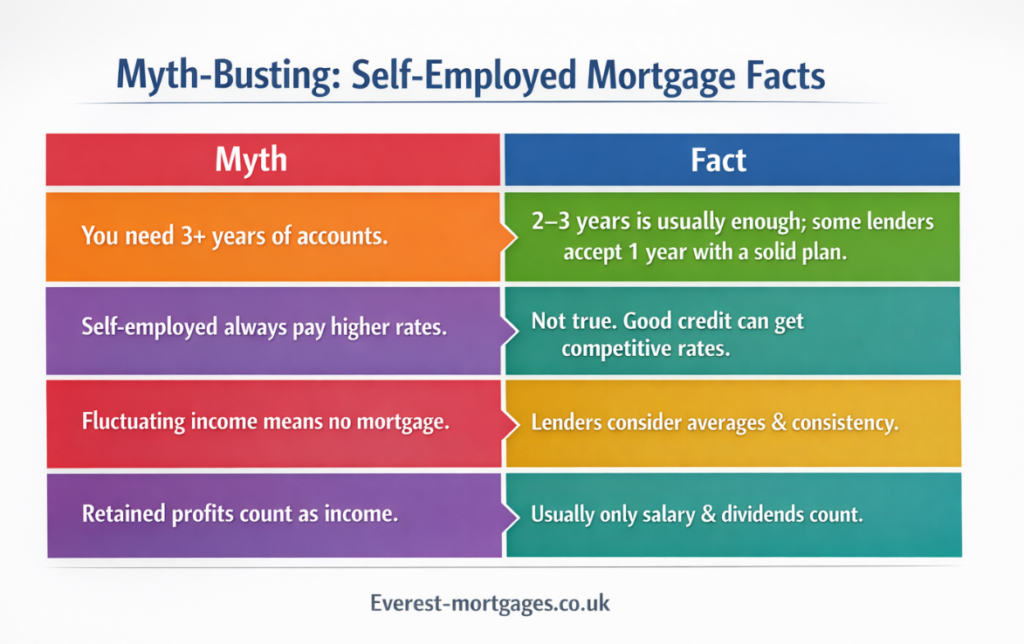
Myth-Busting: Self-Employed Mortgage Facts
There are plenty of myths about self-employed mortgages that can make the process seem scarier than it is.
Navigating the Market, Specialist Lenders & Local Expertise
Getting a mortgage as a self-employed professional in Brighton & Hove can feel harder than expected. However, knowing the right lenders and understanding the local market makes the process much clearer.
Having worked with a wide range of lenders across Brighton and Hove, we support self-employed buyers by helping them understand lender expectations and navigate the process with confidence. This is what you need to know.
Specialist Lenders & Flexible Mortgage Options
Some lenders are more flexible than the big banks, especially for self-employed applicants. They usually have more relaxed criteria and are willing to consider complex income situations, such as day rates, freelance contracts, or future earnings. Some may even consider just one year of accounts or alternative ways to prove your income.
Certain lenders focus on specific professions or sectors, so if you’re a contractor or freelancer, there may be niche products for you. The only challenge for many self-employed people is finding lenders who actually understand their finances, and specialist lenders are designed to do just that.
Why a Local Mortgage Broker is Invaluable?
So far, we have found that working with a local Brighton & Hove mortgage broker can make life so much easier. They give you access to more lenders, including specialists, and can match your unique financial situation to the right product.
Local brokers know the ins and outs of lender requirements and the Brighton & Hove property market. They understand which areas are competitive, what properties are in demand, and which lenders are more flexible locally.
At Everest Mortgages, we work closely with self-employed buyers and can help you connect with trusted local brokers who understand your needs. Consulting an experienced broker can save you time, reduce stress, and help you secure better mortgage deals.
You can also find reputable local brokers via directories like VouchedFor or Unbiased, but having our guidance ensures you’re matched with someone who knows the Brighton and Hove market and self-employed lending inside out.
Brighton & Hove Property Market Insights
Understanding the local property market is just as important as understanding lenders. Property prices vary across Brighton and Hove. Areas like Kemptown, Worthing, Fiveways, Portslade and West Sussex each have their own trends. The market is highly competitive, and common property types include terraced houses, Regency-style homes, and flats.
We know the Brighton & Hove property market very well and understand which areas have the highest demand and how property values can affect borrowing. A solid mortgage application is essential, and our guidance helps self-employed buyers set realistic expectations for their budget and the type of property they can afford.
FAQs
1. What if my income goes up and down a lot?
Lenders usually look at averages over time rather than month-to-month fluctuations. Showing consistent overall earnings helps a lot.
2. Can I get a mortgage with only one year of accounts?
Yes, some lenders will consider it, especially if you can provide clear forecasts and a detailed business plan.
3. Do I need a bigger deposit as a self-employed applicant?
Not necessarily, but having a larger deposit can improve your chances and give you access to better mortgage deals.
4. How do business expenses affect how much I can borrow?
High expenses can lower your assessed income, which affects borrowing. Keeping clear, well-organised accounts and separating essential from discretionary expenses can help.
5. What are SA302s and Tax Year Overviews, and how do I get them?
These are official documents from HMRC that show your income from self-employment. You can download them from your HMRC online account or request them by post.
6. Are there specific schemes or grants for first-time self-employed buyers?
Some schemes may exist, but availability can vary. A local broker will know the latest options for Brighton & Hove first-time buyers.