Quick Answer: Remortgaging in Hove
Remortgaging in Hove means switching your current mortgage to a better deal, usually to save money or release equity. The best time is 4–6 months before your fixed rate ends. Your options depend on factors like LTV, income, and property type (common in BN3). Deals and rates vary by lender, so comparing early can help secure better terms.
What Is Remortgaging?
Remortgaging is simply when you switch your mortgage to a new deal, either with a different lender or by taking a new rate with your current one. Most people do this to get a better interest rate, change their term, or borrow more money.
There are two main options:
- Remortgaging: moving your mortgage to a completely new lender
- Product transfer: staying with your current lender but switching to a new deal
Both can work. It really depends on your situation, and what each lender is willing to offer. However, this always varies based on affordability, credit profile, and criteria.
Why this matters? Because many homeowners in areas like BN3 (Hove) or BN1 (Brighton) just accept their lender’s offer without checking the wider market, and that can cost more over time.
Why Do Homeowners in Hove Remortgage?
In places like Hove, where property values are relatively high, around £410,000 on average (ONS HPI, Dec 2025), even small rate changes can make a big difference to monthly payments.
Below are the most common reasons people remortgage.
- To save money: Switching to a lower rate can reduce monthly costs, although rates have been volatile, with average UK fixed deals recently around ~5% (Moneyfacts, Mar 2026)
- Fixed deal ending: Many people remortgage when their fixed rate ends to avoid moving onto a lender’s higher SVR, which can be significantly more expensive, depending on the lender)
- Releasing equity: Homeowners in Hove often unlock value for things like:
- Loft conversions in Victorian terraces (common around Poets Corner)
- Extensions in family homes near Hangleton or West Hove
- Debt consolidation: Some use remortgaging to roll debts into one payment, but this depends on lender criteria and can increase total interest over time
- Changing the term: Either to reduce monthly payments or pay the mortgage off faster
- Lifestyle upgrades: With rising living costs, some households remortgage to improve cash flow
When Is the Right Time to Remortgage?
Timing your remortgage can play a huge role, especially in a place like Hove, where loan sizes are usually higher than the UK average. Below are the main situations when it’s worth looking into, but keep in mind, what you qualify for always depends on your lender, affordability, and credit profile.
Your Fixed-Rate Deal Is About to End
This is the most common trigger. When your deal ends, you’ll usually be moved onto your lender’s SVR (standard variable rate), which is often much higher. For example, SVRs have recently been around 7.13% on average, compared to roughly 4.95%–5.45% for fixed deals (Moneyfacts, March 2026)
That’s a big jump, so many Hove homeowners, especially in areas like BN3 or Poets Corner terraces, start looking 4–6 months early to avoid it. Setting a reminder actually helps more than people think.
You’re Already On an SVR
If you’re on an SVR, your rate can go up or down at any time, which makes budgeting harder. Typical SVRs are still higher than most fixed deals, around 5%–6.5%, depending on lender (MoneySavingExpert, March 2026). Switching off an SVR can save money in many cases but not always, as deals and eligibility vary.
Your Property Value Has Gone Up
If your home in Hove has increased in value, which has generally been the trend in Brighton & Hove, though it can fluctuate, your loan-to-value (LTV) improves. That matters because:
- Lower LTV = access to better rates (in many cases)
- Lenders may offer more competitive deals if you now sit in a lower risk bracket
It’s worth getting an updated valuation, especially for period flats near Hove seafront and family homes in Hangleton or West Hove.
You Want to Release Equity
Some homeowners remortgage to borrow more, for example:
- Extending a terraced house
- Renovating older properties, which is common in BN3
- Funding a business or other investments
This depends heavily on affordability checks and lender rules, so it’s not guaranteed.
Interest Rates Look Favourable or Are Changing)
Mortgage rates have been quite up and down recently:
- The average 2-year fixed rate is now around 5.28%
- The average 5-year fixed rate is around 5.32%
At the same time, hundreds of deals, close to 700–1,000 have been pulled from the market in just a few weeks as lenders reprice products (Moneyfacts, Mar 2026).
This means that rates are shifting quickly, and deals don’t always stick around for long. So if you’re thinking about remortgaging in Hove, timing can matter, but locking in the perfect rate isn’t guaranteed, as everything depends on lender criteria, affordability, and how the market moves next.
Your Finances Have Improved
If your situation is stronger than when you first got your mortgage, you might get access to better deals:
- Higher income
- Lower debts
- Improved credit score
This can help, but lenders still apply their own affordability rules, so outcomes vary.
Navigating the Remortgaging Journey: Step-by-Step Process
Remortgaging might sound complicated, but in reality, it follows a fairly standard process. The exact timing can vary depending on the lender, your situation, and how quickly documents are provided, but here’s a simple breakdown of what to expect if you’re remortgaging in Hove.
1. Initial Assessment & Research (Start 4–6 Months Early)
The first step is reviewing your current mortgage and deciding what you want to achieve: lower payments, releasing equity, or fixing your rate again.
You’ll usually:
- Check your current deal and expiry date
- Look at rough property values, especially in areas like BN3 or West Hove)
- Use online calculators to estimate new payments
Starting early, around 4–6 months before your deal ends gives you more options and helps avoid slipping onto a higher SVR.
Typical timeframe: 1–2 weeks
2. Review Your Credit Report
Before applying, it’s a good idea to check your credit profile. You can use services like Experian, Equifax, or Credit Karma to check your score and spot errors or outdated information. Fix any issues early. Even small corrections can improve what deals you may qualify for.
Typical timeframe: 1–3 days
3. Speak to a Mortgage Broker
Next, many homeowners choose to speak with an independent mortgage broker, ideally someone familiar with the Brighton & Hove market. They will:
- Assess your income, debts, and affordability
- Compare deals across lenders
- Recommend suitable options based on your situation
This step is especially useful if your case isn’t straightforward, e.g., self-employed, variable income, or looking to release equity.
Typical timeframe: 1–2 weeks
4. Gather Your Documents
You’ll need to prepare documents to support your application. These usually include:
- Proof of ID (passport/driving licence)
- Proof of income, including the last 3–6 months of payslips
- P60 if employed, or SA302s/tax returns, usually 1–2 years if self-employed
- Bank statements covering the last 3–6 months for personal accounts
- Details of other debts, including credit cards, personal loans, and car finance
- Existing mortgage details
Typical timeframe: 1–2 weeks
5. Get an Agreement in Principle (AIP)
An AIP is a quick indication from a lender showing how much you might be able to borrow based on initial checks. It’s not a full approval. But it gives a useful benchmark before applying
Typical timeframe: 1–3 days
6. Submit Your Full Mortgage Application
Once you’ve chosen a deal, you’ll submit a full application. At this stage, the lender will:
- Run detailed affordability checks
- Review your documents
- Carry out credit checks
This is where things become more formal, and timelines can vary depending on complexity.
Typical timeframe: 1–2 weeks
7. Property Valuation
The lender will arrange a valuation of your Hove property to confirm its current market value. This could be a desktop, automated, or in-person valuation. It helps determine your loan-to-value (LTV)
For example, period flats near Hove seafront or terraced homes in Poets Corner may be assessed differently depending on condition and market demand.
Typical timeframe: 1–2 weeks
8. Mortgage Offer Issued
If everything checks out, the lender will issue a formal mortgage offer. This document includes your interest rate, monthly payments, and terms and conditions. It’s worth reviewing this carefully, a solicitor or broker can help explain anything unclear.
Typical timeframe: 2–4 weeks
9. Legal Work (Conveyancing)
A solicitor handles the legal side of switching your mortgage. They will:
- Check property ownership and title deeds
- Liaise with your current and new lender
- Arrange repayment of the old mortgage
In areas like Brighton & Hove, most properties are already registered with HM Land Registry, which helps speed things up, but delays can still happen.
Typical timeframe: 4–8 weeks
10. Completion (Final Step)
This is when everything is finalised. The new lender pays off your old mortgage. And your new deal officially starts. You receive confirmation from your solicitor. From this point, you’ll begin making payments on your new mortgage terms.
Typical timeframe: 1 day
Most remortgages take 4 to 8 weeks in total, but it can be quicker or slower depending on your circumstances, the lender, and how smooth the legal process is. Starting early and staying organised makes a big difference.
Factors That Affect Your Remortgage Options in Hove
When it comes to remortgaging, lenders don’t just look at one thing; they look at your full financial picture and your property. This is how it typically works in simple terms.
A. Your Personal Finances
Your Credit Score
Your credit score plays a big role in what deals you can get.
- A strong score can open the door to better rates and more lenders
- A lower score may limit options or increase the rate offered (this varies by lender)
Check your report at least once a year using tools like Experian or Credit Karma, and fix any errors early. To improve your credit score, focus on building consistent and responsible financial habits. Make sure you pay all your bills on time, as even a single missed payment can have a negative impact.
Try to keep your credit card balances low rather than using up your full limit, as this shows lenders you’re managing credit sensibly. It’s also a good idea to avoid making too many credit applications in a short period, as this
Your Loan-To-Value (LTV)
This is just the percentage of your mortgage compared to your property value.
- Lower LTV (e.g., 60–75%) → usually better rates
- Higher LTV (e.g., 85–95%) → fewer deals and higher rates
If your Hove property has gone up in value, your LTV might have improved, which could help you access better deals.
Your Income and Job Situation
Lenders want to see that you can comfortably afford repayments. They’ll look at your income (salary or business earnings), job stability, and regular expenses and commitments. If you’re self-employed or a contractor, you’ll usually need:
- 1–2 years of accounts or tax returns
- Proof your income is consistent
Your Existing Debts
Lenders also check how much of your income is already going toward debts. Loans, credit cards, car finance; it all counts. Higher debt levels can reduce how much you can borrow. This doesn’t mean you can’t remortgage, just that affordability checks may be tighter.
B. Your Hove Property & Local Market
Property Type Matters
In Hove, property types can vary quite a bit, and lenders do treat them differently. Common examples include:
- Victorian terraces (e.g., Poets Corner): usually straightforward
- Seafront flats: may involve leasehold checks
- New builds: sometimes stricter lending rules
Leasehold flats (very common in BN3) can come with extra checks like ground rent terms, service charges, and lease length. Some lenders can be more cautious here, depending on the details.
Local Property Values
House prices in Brighton & Hove have generally been higher than the UK average, although they can go up or down over time. This means, if your property value has increased, your LTV improves. That may give you access to better remortgage deals.
Areas like Poets Corner, Fiveways, and Preston Park often see steady demand, which can support property values, but nothing is guaranteed, and valuations can vary.
Local Developments and Changes
Things happening around Hove can also impact property values over time. For example, new schools or upgrades, transport links into Brighton or London, and local regeneration projects.
These can sometimes boost property values, which might help your remortgage position but the impact isn’t always immediate or certain.
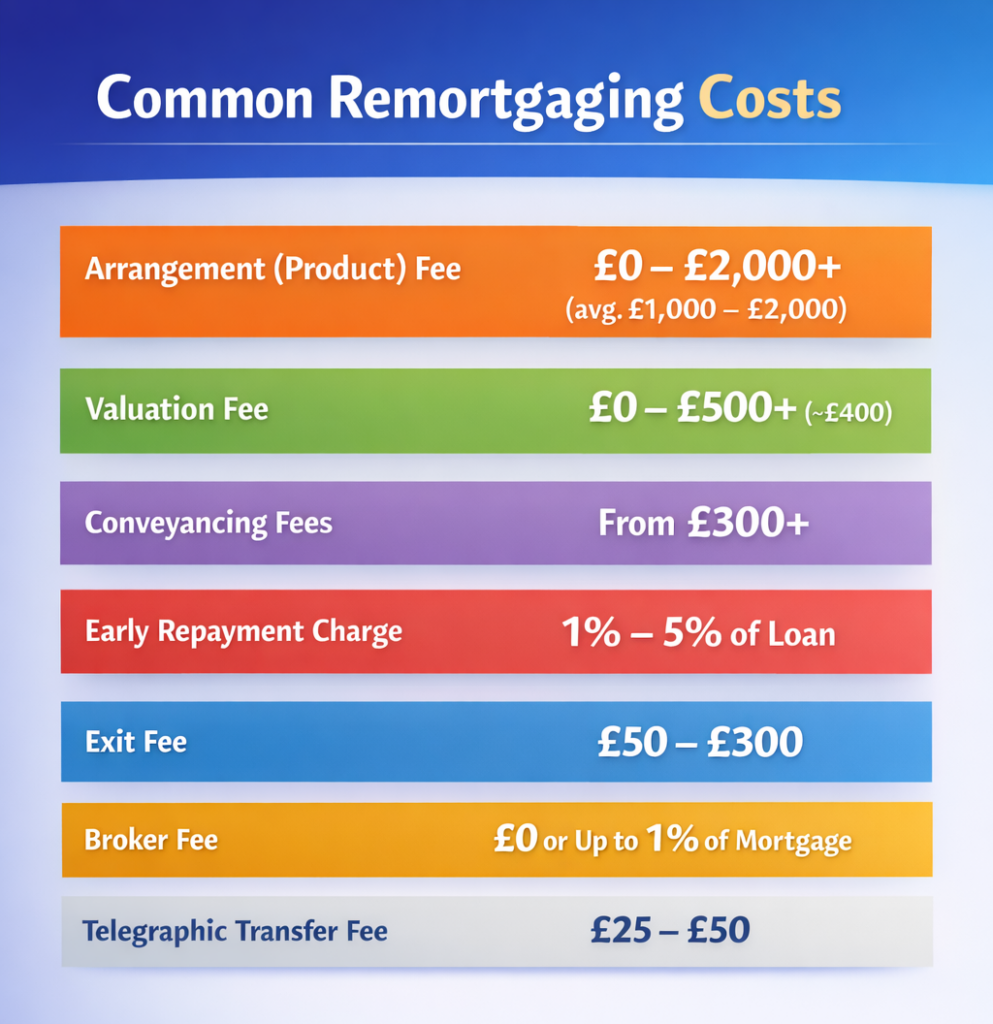
Common Remortgaging Costs
Remortgaging isn’t usually free, but the good news is, not every fee applies to everyone, and some lenders will cover certain costs as part of a deal. Below is an overview of the most common costs, what they involve, and what you can realistically expect to pay.
Arrangement (Product) Fee
This is a fee charged by the new lender for setting up your mortgage, typically ranging from £0 to £2,000+ (often around £1,000–£2,000 on average, Compare the Market/HOA, 2025).
Some deals come with no fee, but they may have slightly higher interest rates. You can usually add this fee to your mortgage, though you’ll pay interest on it over time.
Valuation Fee
The lender needs to check how much your property is worth. It costs usually around £0 – £500+, while sometimes ~£400, depending on lender. (HOA, 2025). Some lenders may offer free valuations as part of remortgage deals.
Conveyancing Fees
This covers the legal work needed to switch your mortgage from one lender to another, with costs typically starting from £300 (HOA, 2025). Some lenders may include free legal work or offer cashback, depending on the deal.
In places like Hove, where many properties are leasehold flats, legal work can sometimes be a bit more involved, so costs can vary.
Early Repayment Charge (ERC)
This is often the biggest cost, and it only applies if you leave your current deal early. Usually around 1% – 5% of your remaining loan (Uswitch, 2026). If you wait until your fixed deal ends, you can usually avoid this completely.
Exit Fee (Admin / Deeds Release Fee)
A small fee your current lender may charge when closing your mortgage. It costs around £50 – £300 (Uswitch, 2026; Eden Conveyancing, 2025). Not all lenders charge this, but it’s worth checking.
Broker Fee
If you use a mortgage broker, they may charge a fee, although many are free. Typically, this is either £0 or up to around 1% of the mortgage value (HOA, 2025). Some brokers are paid by lenders instead, so it’s always worth confirming any fees upfront.
Telegraphic Transfer (TT) Fee
This covers the cost of transferring funds between lenders. It usually ranges from £25 to £50. This is a small cost but rarely waived.
Get a Remortgage Review
If your deal is ending, your rate feels high, or you’re just not sure what options are out there, it’s worth getting a fresh look at your mortgage.
A quick remortgage review can help you see what deals you may qualify for, whether you could reduce your monthly payments, or if releasing equity makes sense for your plans.Get a remortgage review today and see what’s possible based on your current situation, with no pressure, just clear options tailored to you.