Quick Answer: Buy-to-Let Mortgages in Worthing
If you’re considering buy-to-let mortgages in Worthing, most lenders require a 20–25% deposit, rental income that covers 125–145% of mortgage payments, and a solid credit profile. Property prices average around £308,000, while rents average £1,306/month, which can influence rental yield and borrowing limits. Always review lender criteria, taxes, and potential risks before investing.
What is a Buy-to-Let Mortgage?
A buy-to-let (BTL) mortgage is a type of mortgage used to buy a property that you plan to rent out to tenants, rather than live in yourself.
Instead of focusing mainly on your personal salary, lenders usually look at how much rent the property could generate and whether it comfortably covers the mortgage payments.
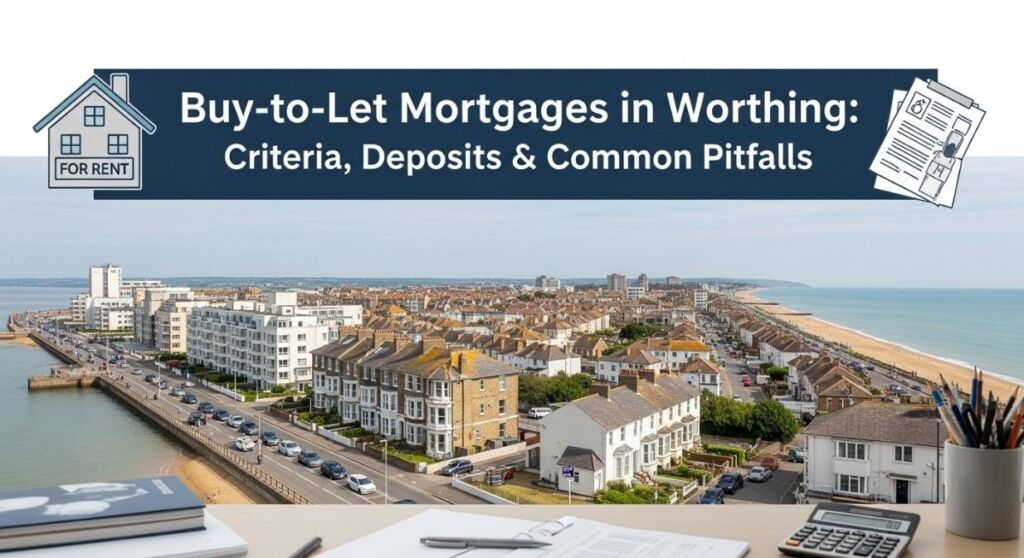
Many landlords use BTL mortgages to invest in flats, terraced houses, or small family homes in rental areas like BN11, BN12, and BN13 in Worthing, where demand can vary depending on location and property type.
Just keep in mind that approval always depends on the lender’s criteria, rental income estimates, and your financial situation.
Introduction to Buy-to-Let in Worthing & Market Dynamics
Worthing has quietly become a popular spot for buy-to-let investors on the South Coast. It offers that classic seaside town feel but still has the everyday convenience of a growing urban area.
You’ve got the beach and promenade, but also a busy town centre, decent shopping areas, and quick connections to bigger cities. That mix makes the town attractive for renters and investors alike.
A few reasons investors often look at Worthing include:
- Coastal lifestyle: Seafront areas like BN11 and BN12 attract renters who want to live close to the beach.
- Commuter convenience: Direct trains from Worthing station to London Victoria usually take around 90 minutes, making it realistic for hybrid commuters.
- Close to Brighton: Worthing sits about 11 miles west of Brighton, so it can feel like a more affordable alternative while still being close to jobs and universities there.
- Local governance: The area is managed by the Worthing Borough Council, which has been supporting regeneration projects, particularly around the town centre and seafront.
You’ll also find a good mix of residents here: young professionals, commuters, families, retirees, and some students from nearby Brighton universities. That diversity tends to support steady rental demand, although demand can vary depending on the exact location and property type.
Rental Market Overview
Worthing’s rental market has been fairly stable in recent years, with demand remaining steady in many areas.
As of January 2026, the average private rent in Worthing is about £1,306 per month, up from £1,276 a year earlier (ONS Private Rental Price Index, Jan 2026).
Typical rents by property size look roughly like this:
- 1-bed property: about £896/month
- 2-bed property: about £1,189/month
- 3-bed property: about £1,436/month
- 4-bed+ property: about £1,953/month
(ONS Private Rental Price Index, Jan 2026)
These numbers can vary a lot depending on location and property condition. For example:
- West Worthing and Goring-by-Sea often attract families looking for houses with gardens.
- Central Worthing (BN11) tends to have more flats and smaller rentals close to the station and seafront.
- Durrington and BN13 areas can be slightly more affordable entry points for investors.
Because of that mix, many landlords find that flats and small terraced homes are the most common buy-to-let choices locally. But yields and tenant demand will always depend on the property, location, and lender criteria.
Local Property Price Trends
Property prices in Worthing have been relatively stable recently compared with some other South East markets.
The average house price in Worthing was around £308,000 in December 2025 (ONS, Dec 2025). Typical prices by property type include:
- Detached: about £613,000
- Semi-detached: about £424,000
- Terraced: about £337,000
- Flats/maisonettes: about £188,000
(HM Land Registry HPI, Dec 2025)
That pricing structure is one reason some investors start with flats or smaller terraces, as the entry price can be lower than in nearby Brighton.
Of course, prices change over time and can vary street-by-street, so actual affordability and investment returns will always depend on the property and lender assessment.
Why Some Investors Prefer Worthing Over Nearby Towns
Compared with nearby South Coast locations, Worthing sometimes stands out for a few practical reasons:
More Affordable Than Brighton
Brighton is only a short train ride away but typically has higher property prices, which can make Worthing a more accessible entry point for some landlords.
Strong Commuter Appeal
Many renters working in Brighton, Crawley, or London look for slightly cheaper coastal living.
Varied Housing Stock
The town offers a mix of:
- Period seafront flats
- Victorian terraces in West Tarring and Heene
- Post-war family homes in Durrington and Salvington
That variety gives investors more options depending on budget and strategy.
Common Buy-to-Let Mortgage Types
When choosing a buy-to-let mortgage, landlords usually decide between a few main options.
1. Interest-Only vs Repayment
Interest-only mortgages are a common option for many buy-to-let investors. With this type of mortgage, you only pay the interest on the loan each month, not the loan amount itself. Because of this, the monthly payments are usually lower, which can make it easier to manage rental cash flow.
Repayment mortgages, on the other hand, work more like a standard home loan. Your monthly payment covers both the interest and a portion of the loan, so the mortgage balance gradually reduces over time. This means you slowly build equity in the property, which can provide more long-term security. The trade-off is that the monthly payments are usually higher compared with interest-only mortgages.
Fixed-Rate vs Variable-Rate
Fixed-rate mortgages keep the interest rate the same for a set period, usually 2, 3, or 5 years. This means your monthly payments stay predictable, which can make budgeting easier. Many landlords choose fixed rates because they offer protection if interest rates rise during the fixed period.
Variable-rate mortgages work differently because the interest rate can move up or down over time, often linked to the lender’s standard variable rate or the Bank of England base rate. This means your monthly payments may change. While these mortgages sometimes start with lower initial rates, they come with less certainty about future payments.
Navigating BTL Mortgage Criteria & Deposit Requirements
Before applying for a buy-to-let mortgage, lenders will usually check a few personal eligibility factors. These rules can vary from lender to lender, but most applications are assessed using similar criteria.
Age Restrictions
Most buy-to-let lenders set both minimum and maximum age limits. Typically, applicants must be at least 18–21 years old when the mortgage starts, and many lenders want the mortgage term to finish before the borrower reaches around 75–85 years old. Exact limits vary by lender and product.
Personal Income
Even though buy-to-let mortgages mainly rely on rental income, many lenders still want applicants to have a minimum personal income, often around £25,000 per year. This gives lenders confidence that you could still cover payments if the property becomes vacant or rental income drops.
However, some specialist lenders may not set a strict income minimum, depending on the overall application.
Existing Property Ownership
Many lenders prefer borrowers who already own their own residential home. The idea is that homeowners have some experience managing a mortgage and property costs.
That said, a few lenders may still consider first-time landlords or renters, although the criteria can be stricter and the number of available deals may be smaller.
Credit Score Importance
Your credit history also plays a big role in whether you’re approved and what interest rate you’re offered. Lenders typically review things like:
- Missed or late payments
- County Court Judgments (CCJs)
- Previous defaults or financial issues
A strong credit profile can help you access better mortgage deals, while weaker credit may limit options or require a larger deposit.
What is ICR?
When lenders assess a buy-to-let mortgage, the main affordability check is called the Interest Cover Ratio (ICR). In simple terms, this looks at whether the expected rental income comfortably covers the mortgage interest payments. A simplified way to think about it is:
Expected monthly rent ÷ stressed mortgage interest payment
Lenders usually don’t calculate this using the exact mortgage rate. Instead, they apply a stress test to make sure the property would still be affordable if interest rates increased.
Stress Rates and Interest Buffers
Most lenders stress-test buy-to-let mortgages at around 125%–145% of the mortgage interest, often using a notional interest rate of about 5–6%, depending on the lender and borrower tax status (UK Finance lender guidance, 2025). If the rental income doesn’t meet this stress test, the lender may:
- Reduce the amount you can borrow
- Ask for a larger deposit
- Decline the application
Because of this, higher stress rates can reduce borrowing capacity, even if the property seems affordable at today’s interest rates.
Example Using a Worthing Property
Let’s say you’re buying a small two-bed flat in BN11 Worthing and the expected rent is £1,200 per month.
If a lender requires 145% ICR, they’ll check whether that rent comfortably covers the stressed mortgage payment. If it doesn’t, they may lower the loan amount you can get.
Actual calculations vary between lenders and depend on the mortgage rate, loan size, and tax status.
Deposit Requirements & Loan-to-Value (LTV)
Minimum Deposit for Buy-to-Let
Most buy-to-let mortgages require a deposit of around 20–25% of the property value. Some lenders may ask for more depending on the property, borrower profile, or market conditions.
Generally, the bigger your deposit, the more mortgage options you’ll have.
What is Loan-to-Value (LTV)?
Loan-to-Value (LTV) shows how much you’re borrowing compared to the property value. For example:
- 75% LTV → You borrow 75% and provide a 25% deposit
- 60% LTV → You borrow 60% and provide a 40% deposit
Lower LTV ratios usually mean lower risk for lenders, which can sometimes lead to better interest rates.
How Deposit Size Can Affect Rates
As a rough guide:
- 75% LTV mortgages tend to have higher interest rates
- 60% LTV mortgages may offer lower rates and more product choices
Exact rates change frequently and always depend on lender criteria and market conditions.
Where Your Deposit Can Come From
Buy-to-let deposits typically come from sources like:
- Personal savings
- Equity released from another property
- Gifted deposits from family (some lenders allow this with conditions)
Lenders will usually want clear evidence showing where the deposit funds came from.
Buy-to-Let Taxes & Fees
When buying a buy-to-let property, there are several taxes and upfront costs to budget for. These can significantly affect your overall investment returns.
Stamp Duty Land Tax (SDLT)
Buy-to-let properties usually count as additional residential properties, so they attract higher SDLT rates. Since April 2025, the rates for additional properties in England are roughly:
- Up to £125,000 → 5%
- £125,001 – £250,000 → 7%
- £250,001 – £925,000 → 10%
- £925,001 – £1.5M → 15%
- Above £1.5M → 17%
(HMRC SDLT guidance update, Apr 2025; UK property tax guides, Jan 2026)
For example, buying a £300,000 buy-to-let property could result in about £20,000 in SDLT, which investors should factor into their initial budget. Many investors use online SDLT calculators to estimate these costs before making an offer.
Income Tax on Rental Income
Rental income is generally taxed as regular income, based on your tax band (typically 20%, 40%, or 45% in England). Landlords can deduct certain allowable expenses such as maintenance, letting agent fees, and insurance to reduce taxable profit.
A key rule to understand is Section 24, which limits how much mortgage interest landlords can deduct. Instead of deducting interest fully, landlords usually receive a basic-rate (20%) tax credit on mortgage interest costs, which can increase tax bills for higher-rate taxpayers.
Capital Gains Tax (CGT)
If you sell a buy-to-let property later and make a profit, you may have to pay Capital Gains Tax on the gain. The tax is calculated based on the difference between the purchase price and sale price, after deducting allowable costs such as legal fees and improvements. CGT rates depend on your tax band and current allowances.
Other Common Costs
Besides taxes, investors should also budget for several transaction and setup fees, including:
- Solicitor or conveyancing fees
- Property valuation fees required by the lender
- Mortgage arrangement or product fees
- Survey costs and landlord insurance
These costs can vary depending on the lender, property value, and legal complexity, but they are important to include in your overall buy-to-let investment calculations.
Yield Sensitivity Examples
Rental yield can change quite quickly if rent levels, mortgage rates, or property prices move. Running a few simple scenarios helps investors understand how sensitive their returns might be.
For example, imagine a £300,000 buy-to-let property in Worthing (BN11) renting for £1,250 per month (£15,000 per year).
Baseline scenario
- Property price: £300,000
- Annual rent: £15,000
- Gross yield: 5.0%
If rent drops by 10%
- Annual rent: £13,500
- Gross yield: 4.5%
If interest rates increase
If a landlord has a 75% mortgage (£225,000) and the interest rate increases from 4.5% to 6%, annual interest costs could rise from roughly: £10,125 → £13,500 per year. That increase can significantly reduce monthly cash flow unless rents also rise.
Mitigating Risks & Avoiding Common Buy-to-Let Pitfalls
Like any property investment, buy-to-let comes with risks. The key is planning ahead and putting simple safeguards in place so unexpected issues don’t affect your cash flow or long-term returns.
Underestimating Costs
One of the most common mistakes new landlords make is focusing only on the mortgage payment and forgetting about other costs.
Besides the purchase price, you may need to budget for:
- Stamp Duty Land Tax
- Legal and mortgage fees
- Property maintenance and repairs
- Letting agent fees
- Insurance and safety checks
A good approach is to create a full investment budget before buying, including a contingency fund for unexpected repairs or empty rental periods.
Tenant Issues
Another challenge can be finding reliable tenants. Problems like rent arrears, property damage, or frequent tenant turnover can quickly affect your rental income. Some ways landlords reduce this risk include:
- Carrying out tenant referencing and credit checks
- Asking for employment and income verification
- Using a deposit protection scheme
- Working with a professional letting agent
These steps can help lower the chances of tenancy disputes later.
Regulatory Changes
Landlord regulations change regularly, so it’s important to stay informed about legal requirements. For example, landlords may need to comply with rules around:
- EPC energy efficiency ratings
- Right to Rent checks
- Gas and electrical safety certificates
Many landlords follow updates from organisations like the National Residential Landlords Association, which provides guidance and resources on new regulations.
Interest Rate Risks
Mortgage interest rates can change over time, especially if you have a variable-rate mortgage or when a fixed deal ends. Higher rates can increase monthly payments and reduce rental profits.
It’s worth reviewing your mortgage regularly. Remortgaging at the right time could help secure a better rate and improve your monthly cash flow.
Property Market Fluctuations
Property values and rental demand can also change depending on the local market and wider economic conditions.
In towns like Worthing, factors such as commuter demand, coastal property supply, and local development projects can influence prices and rental yields over time.
A good strategy is to focus on long-term investment potential, rather than short-term price movements.
Proactive Pitfall Prevention
To reduce risk as a landlord:
- Build a financial buffer for void periods and repairs
- Carefully screen tenants before signing agreements
- Stay updated on landlord regulations
- Review your mortgage deal regularly
Taking these steps early can help make a buy-to-let investment more stable and sustainable over the long term.
Ready to Take the Next Step?
Buy-to-let investing can be rewarding, but navigating mortgages, deposits, and rental income rules can be tricky. Speak to a buy-to-let adviser today to get personalised guidance, compare lenders, and make sure your investment in Worthing works for you.