Quick Answer: Are Independent Mortgage Advisors Better in Hove?
Independent mortgage advisors in Hove can typically offer access to a broader range of lenders than most banks (though this varies by firm), which is useful in a high-price market like BN3 where property values are often £300k–£800k+. They help match borrowers to suitable lenders for flats, houses, and complex income cases. However, outcomes always depend on affordability, and individual circumstances.
Defining the Role
An independent mortgage advisor is a qualified professional who reviews a wide range of mortgage options and recommends what best fits your situation. They are not tied to a single lender or a small panel, which allows them to compare deals across a broad range of lenders rather than pushing one provider’s products.
In contrast, ‘tied’ advisors, like those working inside a bank, can only offer that lender’s products, while ‘restricted’ advisors may work from a limited panel of lenders.
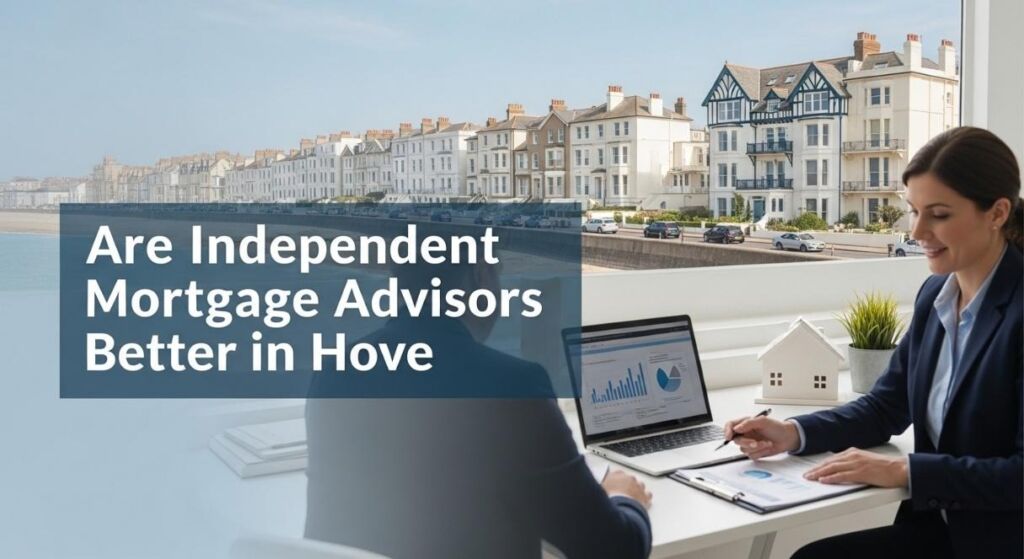
In practical terms, if you walk into a high street branch in areas like Hove; for example, along Church Road or near BN3 postcodes, you are typically speaking to a tied advisor. That immediately narrows your options before you even start.
“Whole-of-Market” vs. “Restricted” Advice
This is where things get misunderstood. A ‘whole-of-market’ advisor is expected to review a broad range of lenders across the UK, including high street banks, building societies, and some specialist providers.
However, this does not always mean every single lender. Some operate from panels, and some lenders only offer deals directly. In practice, the exact number of lenders available will vary depending on the advisor’s panel, network, and permissions.
A restricted advisor, on the other hand, works with a smaller selection of lenders. This could be a panel of 10–20 providers, often linked to estate agents or networks. If the best deal sits outside that panel, it simply won’t be offered.
Always ask how many lenders the advisor can access and whether they are truly independent or working from a panel. The difference can matter more in complex cases (e.g., self-employed buyers or flats in converted Regency buildings common across Hove), where lender criteria vary significantly.
Speak to a Mortgage Adviser Who Understands Hove
If you are unsure whether your situation needs a whole-of-market advisor or something more straightforward, it is worth getting clarity early.
At Everest Mortgages, we help buyers and homeowners across Hove understand which lenders from our available panel are most realistic for their situation, so they avoid wasting time applying in the wrong place.
See your real mortgage options clearly, tailored to your profile and the Hove market.
Client-Centric Approach
Independent advisors are expected to focus on your circumstances first, not a lender’s targets. That usually means:
- Reviewing your income, outgoings, and credit profile
- Understanding your long-term plans, e.g., staying in Hove long-term vs. short-term move
- Matching you with lenders whose criteria actually fit your situation
For example, buying a leasehold flat near Hove seafront or in BN3 often involves specific lender rules around lease length or building type. Not every lender accepts these, so having broader access can make a practical difference.
That said, outcomes still vary by lender and are subject to affordability and lender criteria, especially for higher LTV borrowing in Hove or non-standard properties.
The Regulatory Framework
Mortgage advice in the UK is regulated by the Financial Conduct Authority (FCA). This matters because:
- Advisors must clearly state whether they are independent, whole-of-market, or restricted
- They must recommend products that are suitable based on your circumstances
- You are protected if advice is unsuitable or misleading
You can verify any advisor on the FCA Register before proceeding. This is not optional if they are not listed, you should not use them.
Why Choose an Independent Mortgage Advisor in Hove?
Access to a Wider Market
In a place like Hove, this is not just a ‘nice to have’, it is often necessary.
According to the Office for National Statistics, the average price of a mortgaged home in Brighton and Hove was £407,000 in February 2026 (provisional), down slightly from £419,000 in February 2025.
Pricing in Hove is not just high; instead, it varies significantly by property type, which directly affects lender decisions.
The average prices in Brighton and Hove as of February 2026 were:
- Detached: £841,000
- Semi-detached: £538,000
- Terraced: £467,000
- Flats and maisonettes: £293,000 (ONS, Feb 2026)
On paper, flats appear more affordable. But in Hove, especially across BN3, the reality is more complex:
- many flats are leasehold, often with service charges and lease restrictions
- a large share are period conversions, particularly near the seafront and central Hove
This is where access to a broader range of lenders matters. Some lenders are stricter on shorter leases (e.g., approaching 80 years), higher service charges, and non-standard construction in older buildings.
Others are more flexible, but you will not see those options if you are limited to a single bank or a small panel. Even for houses, higher values (e.g., £500k–£800k+ for semi-detached or detached homes) mean:
- tighter affordability assessments
- greater sensitivity to interest rates
- more scrutiny on income, especially for self-employed buyers
An independent advisor can compare across lenders with different criteria models, which increases the chances of finding a workable option.
At Everest Mortgages, this is exactly where we add value. We work with a broad panel of lenders, including high street and specialist providers, and understand how different criteria apply to Hove properties, from leasehold flats in BN3 to higher-value homes and complex income cases.
Instead of trial-and-error with multiple lenders, we help you focus on the ones more likely to accept your application, reducing the risk of unsuitable applications and giving you a clearer path forward.
Unbiased and Tailored Advice
The main advantage is simple: you are not limited to one bank’s view of your situation. Instead of being told what a single lender can offer, an independent advisor compares options and filters them based on your income structure, deposit level, and long-term plans, e.g., staying in Hove vs. relocating.
For example, first-time buyers in Hove often face entry prices around £339,000 on average (ONS, Feb 2026). That can push borrowing limits, especially for single applicants. A broader lender search can sometimes identify more flexible affordability models but again, this depends on individual circumstances and lender rules.
Time and Convenience
The reality is that the UK mortgage market is complex, and Hove adds another layer due to property types and pricing. An independent advisor typically:
- compares multiple lenders at once
- explains eligibility in plain terms
- handles paperwork, submissions, and follow-ups
Without that, you would need to approach lenders individually, repeat applications, and interpret different criteria yourself. That is where most buyers get stuck or overwhelmed.
Solving Hove’s Local Challenges
Hove is not a standard market. A few local factors regularly affect mortgage outcomes:
- High proportion of flats (over half of sales), many with leasehold structures
- Older housing stock, including period conversions that may not meet all lenders’ criteria
- Price variation by postcode, e.g., BN3 1 (central/seafront) vs. BN3 5 (more residential streets)
- Tighter affordability due to higher average prices
An advisor with access to a wider lender pool is more likely to navigate these issues effectively. For example, some lenders are stricter on lease length, e.g., under 80 years, while others are more flexible; this is where ‘whole-of-market’ access actually matters in practice.
Clear Path Through Complexity
Most buyers are not short on options; they are overwhelmed by them. An independent advisor helps by:
- narrowing choices to realistic options
- explaining trade-offs (rate vs. fees vs. flexibility)
- guiding you from decision to completion
That structure is often more valuable than simply “finding a deal.”
Independent vs. Bank Mortgage Advisors
| Feature | Independent Advisor | Bank Advisor |
| Product Range | Wide lender access (often “whole-of-market”, varies) | Own products or limited panel |
| Impartiality | Broader, more flexible recommendations | Restricted to bank offerings |
| Fees | May charge a fee (disclosed upfront) | Usually no direct fee |
| Personalisation | More tailored to individual circumstances | More standardised |
| Local Insight | Can reflect local factors (e.g., BN3 flats, leaseholds) | Limited local focus |
| Process Handling | Manages full application end-to-end | Focused on own products |
| Best For | Complex cases, wider choice | Simple cases, existing customers |
Understanding Independent Mortgage Advisor Fees & How They Work
Mortgage advisors in the UK are typically paid in three main ways:
- Fixed fee: Often around £400–£500 on average (Unbiased / Compare My Move, Jan 2026)
- Percentage-based: Usually ~0.35%–1% of the loan amount
- Commission-only: Paid by the lender (most common model)
- Hybrid: A mix of client fee + lender commission (less common)
In practice, more than half of brokers charge no direct fee (around 55% in 2024, FCA data), while most others charge under £500.
Lender commission, called a procuration fee, is typically around 0.3%–0.4% of the mortgage amount.
Always confirm in writing whether you are paying a fee, whether the broker receives commission, or both.
Transparency and Disclosure
Mortgage advice in the UK is regulated by the Financial Conduct Authority, and fee transparency is not optional. You should expect:
- A clear Initial Disclosure Document (IDD) or similar
- A breakdown of all fees and commissions before proceeding
- A Key Facts Illustration (KFI) showing costs linked to your mortgage
Regulation also requires that any commission received must not influence the recommendation.
Value for Money
Paying a fee does not automatically mean better advice, but in some cases, it can be justified. Value typically comes from:
- access to lenders you would not approach yourself
- potentially better-suited products (not just headline rates)
- time saved and fewer failed applications
For example, in markets like Hove where property values are higher and lending criteria tighter, even a small rate difference can outweigh a £300–£500 broker fee over time. That said, results vary by lender, rates, and your individual circumstances.
Negotiating Fees
Fees aren’t fixed and vary by case. Simple applications may be fee-free, while complex ones like self-employed or adverse credit, usually involve a fee. Some advisors may adjust or waive fees based on the loan size or complexity. Always ask upfront, compare options, and don’t assume all brokers charge the same.
Practical Example: Buying a Flat in Hove (BN3)
First-time buyer purchasing a £380,000 leasehold flat in BN3 with a 10% deposit and mixed income (salary + bonus). The property has an ~82-year lease.
Without independent advice:
- Bank applies stricter rules on bonus income and lease length
- Reduced borrowing or possible decline
- Time lost reapplying elsewhere
With an independent advisor:
- Identifies lenders more likely to be flexible on bonus income
- Higher chance of approval first time
- Smoother, faster process
In Hove, small details like lease length and income type can make or break an application—choosing the right lender from the start matters.
Choosing the Best Independent Mortgage Advisor in Hove
A simple, practical checklist to avoid poor advice and find a reliable mortgage advisor.
1. Check FCA Authorisation
Check the advisor on the Financial Conduct Authority Register and ensure they are authorised to provide mortgage advice. If they are not listed or regulated, avoid proceeding with them.
2. Assess Experience & Local Knowledge
Ask whether they regularly handle Hove (BN3) properties and have experience with flats, leasehold, and period conversions. Also confirm if they are whole-of-market or work from a restricted panel.
3. Understand Fees Clearly
- Request a full written breakdown of fees and commissions
- Confirm costs before any application starts
- Ensure all agreements are documented
4. Evaluate Communication
- Check how quickly they respond and how they stay in touch
- Ask who handles your case day-to-day
- Confirm availability during key stages (offer, valuation, completion)
5. Check Reviews & Track Record
Check Trustpilot and Google reviews, paying attention to feedback related to Hove or similar property cases. Where possible, request real case examples to verify their experience.
6. Prepare Before Your First Meeting
- Review your credit report via Experian, Equifax, or TransUnion
- Bring income details, deposit proof, and property goals
- Be clear about budget and timeline
Questions You Should Ask Any Mortgage Advisor
Before you commit, ask these directly:
- How are you paid: fee, commission, or both?
- Will I pay anything if the mortgage doesn’t complete?
- Are you whole-of-market or restricted to certain lenders?
- How many lenders are on your panel, and how many will you consider for my case?
- Do you charge differently for complex cases (self-employed, flats, etc.)?
- How do you decide which mortgage to recommend?
- Will I get everything in writing before I proceed?
In a market like Hove, where property prices are higher and lending criteria can be stricter depending on the property type, the right advice can make the difference between moving forward smoothly or hitting unnecessary delays.
Common Mistakes to Avoid When Choosing a Mortgage Advisor in Hove
Even well-informed buyers make avoidable mistakes, especially in a market like Hove where property types vary widely.
1. Assuming All Advisors Are “Independent”
Not every advisor is whole-of-market. Some work from limited panels. If you do not ask directly, you may never see better options outside that range.
2. Focusing Only on Interest Rates
The lowest rate is not always the best deal. Fees, lender criteria, and flexibility, especially for leasehold flats in BN3, can matter just as much.
3. Not Checking FCA Authorisation
If an advisor is not listed with the Financial Conduct Authority, you should not proceed; no exceptions.
4. Ignoring Local Property Factors
Hove has a high number of leasehold flats and period conversions. Choosing an advisor without experience in these property types can lead to delays or declined applications.
5. Not Clarifying Fees Upfront
Always confirm whether the advisor is paid by commission, client fee, or both, and get it in writing before moving forward.
Speak to an Everest Mortgage Expert Today
At Everest Mortgages, we specialise in helping buyers and homeowners navigate complex mortgage scenarios in markets like Hove, whether you’re dealing with leasehold flats, higher-value properties, or non-standard income.
Book a free 15-minute call with Everest Mortgages and get clear guidance on your real mortgage options in Hove.
Frequently Asked Questions (FAQs)
1. How long does the mortgage process take in Hove with an independent advisor?
Typically, it takes 2–6 weeks from application to mortgage offer, but this can vary. In Hove, timelines are often influenced by:
- high demand in the BN3 market
- leasehold checks (common in flats and conversions)
- valuation delays on period or seafront properties
2. Can an independent advisor help with flats and leasehold properties in Hove?
Yes. This is especially relevant in Hove, where a large share of homes are leasehold flats and converted Victorian or Regency buildings. Some lenders are strict on lease length, service charges, building structure and management companies.
3. What documents will I need to get a mortgage in Hove?
Most lenders will ask for:
- proof of ID (passport or driving licence)
- recent payslips or income proof
- bank statements (usually 3–6 months)
- tax returns if self-employed
- deposit evidence
4. Is it harder to get a mortgage in Hove compared to other areas?
Not necessarily harder, but more criteria-sensitive. Because average prices in Brighton and Hove are relatively high, lenders often apply stricter affordability checks. An independent advisor helps by targeting lenders whose criteria better match your profile.
5. How often should I review my mortgage if I live in Hove?
It is generally recommended to review your mortgage every 2–3 years or at the end of a fixed-rate period. In a market like Hove, where property values and rates can shift quickly, regular reviews can help you avoid moving onto higher standard variable rates.